Kleptomaniacs never get puns because they're always taking things literally.
Cannibals have a lively social life because they're always having people for dinner.
Sunday, August 30, 2015

Haddock's Eyes or What things are called.
The name of the song is called 'Haddocks' Eyes.'"
"Oh, that's the name of the song, is it?" Alice said, trying to feel interested.
"No, you don't understand," the Knight said, looking a little vexed. "That's what the name is called. The name really is 'The Aged Aged Man.'"
"Then I ought to have said 'That's what the song is called'?" Alice corrected herself.
"No, you oughtn't: that's quite another thing! The song is called 'Ways And Means': but that's only what it'scalled, you know!"
"Well, what is the song, then? " said Alice, who was by this time completely bewildered.
"I was coming to that," the Knight said. "The song really is 'A-sitting On A Gate': and the tune's my own invention."
(from Lewis Carroll, Through the Looking Glass)
Once you have the ability name something, even names can have names and then it's turtles all the way down. Once you have the ability to point, you can point at the pointer. Like the mirror test, understanding pointing doesn't guarantee you the ability to grasp all the nth-order pointing.
Once you have the ability name something, even names can have names and then it's turtles all the way down. Once you have the ability to point, you can point at the pointer. Like the mirror test, understanding pointing doesn't guarantee you the ability to grasp all the nth-order pointing.
Friday, August 28, 2015
Just Stop It. Website complaints
A little constructive feedback to web site designers.
Stop it. Please just stop it.
Website designers, stop adding crazy stuff and stop changing my defaults 'for' me:
Tech rationalization: All these things also take up lots of memory and processing time on the local computer running them. Also, they waste my time.
So stop it.
PS IMDB, you're the worst. I love wasting my time on your site. But I don't want to waste away my time-wasting time on waiting for your candy crap ads to load. I want to see them immediately or move on to finding out what the movie was with the thing that that actor (who was in with the actress from that TV show (no not that one, the comedy, no the other more serious comedy) who had that thing happen to him. It was a couple years ago. I think it was a remake?
Stop it. Please just stop it.
Website designers, stop adding crazy stuff and stop changing my defaults 'for' me:
- Stop changing things that I can set up locally. Allow me to set the font size rather than fixing it to what you think is best. Don't change the scroll speed on me, I set it already the way that's easiest for me. I don't want to swipe to move down a paragraph but then you make it skip a page or two.
- Stop it with all the moving images. just a few are OK. Well no not really. One is already almost too much.
- Stop it with the audio. I'm listening to something else. Also, with multiple tabs that I move around, your audio is randomly starting when Im not on your tab. Then there's a frantic search for your goddam tab to kill with a vengeance and remember never to visit anything of yours again.
Tech rationalization: All these things also take up lots of memory and processing time on the local computer running them. Also, they waste my time.
So stop it.
PS IMDB, you're the worst. I love wasting my time on your site. But I don't want to waste away my time-wasting time on waiting for your candy crap ads to load. I want to see them immediately or move on to finding out what the movie was with the thing that that actor (who was in with the actress from that TV show (no not that one, the comedy, no the other more serious comedy) who had that thing happen to him. It was a couple years ago. I think it was a remake?
Thursday, August 27, 2015
Another Design Pattern: Layers
Though I usually talk with software as the underlying example, I call this a general design pattern since it works in many fields.
Layers or layering is a way of separating a large goal into smaller pieces. It is not necessarily by sequence of execution or design but by amount of detail of domain expertise. That is, the
The 'layers' pattern is really a pattern using another pattern, the interface. When the terms 'vertical application' or 'horizontal design are used', horizontal means a general purpose set of tools, vertical means using a ladder of tools, one depending on the next to solve a niche problem.

Note - level 7:mailActual communication over a cable is through the physical layer. There are rules and restrictions on the physical layer that the layer above it conforms to in order to get certain behavior but is easier to think in in the higher abstraction.
It is a stacking of individual components, a higher one depending on a lower one. The higher layer is dependent on the lower one, and is specified in the language of the lower one.
Layers of science - mathematics, physics, chemistry, biology, psychology. Here one may notice that the interactions of the layers is not necessarily one of interfaces: though understanding of physics ostensibly underlies chemistry, understanding the former doesn't guarantee an understanding of the latter. Physics may give insight but won't necessarily determine how chemistry works. This just shows that layers is a general strategy for dealing with a large domain (here science is about as large as it gets).
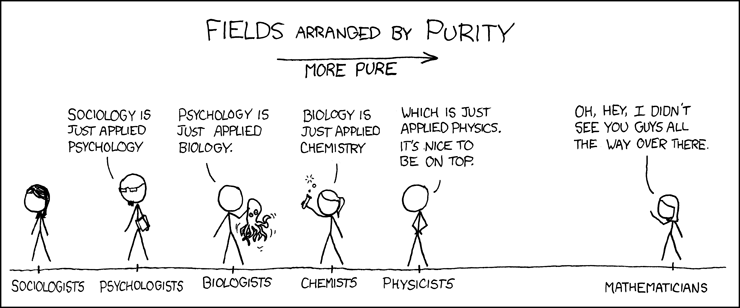
Purity from xkcd
The benefits of the 'layers' pattern is that it cuts up a larger monolithic area into many smaller manageable pieces. Instead of trying to understand the meaning of life, these 'smaller' areas are more manageable. Also, each individual piece can be worked on with a limited vocabulary (that of the lower piece). You don't have to understand all the complexities of the lower layer.
This is another pattern that encourages modularity: the higher layer (the abstract layer) has its own language and ways of doing things implemented in the interface given by the lower layer. The lower layer (and so also layers below it) could be entirely replaced by a different implementation. Or one layer could be replaced given that it respects the interface of its higher and lower layers.
Another example from computers is architecture: electronics, microprogramming, machine language, assembly language, higher level programming language, specification language. A new layers in design can come from either direction: higher level programming languages like C or Fortran came from wanting to abstract away common patterns in assembly language (like subroutines), and microprogramming came from trying to implement machine language more easily in the electronics.
A higher layer is often an abstraction from a lower one. The common patterns can be set in (parameterized) stone in lower ones, with enough freedom to connect those things in the higher layer to get applications done. That way, the higher layer can worry about its problems without having to worry about some implementation details, and the lower layer can worry about its own problems. This is a way of explaining the benefits of encapsulation/modularity/data hiding: reduce the knowledge requirements at each level while maintaining functionality.
One difficulty with layering is making sure the knowledge of the layers is sufficiently compartmentalized, that the user/designer in one layer needs to know as little as possible of other layers. A leaky abstraction occurs when too much is required of those outside a layer.
Without these layers, there can easily be efficiencies that are possible by thinking fast, by the designer of the monolith using fine local information to get benefits in the larger architecture. But this can lead to spaghetti code (spaghetti design), where small changes in a small but common/overused element can cause large changes (or rather problems/bugs/disasters).
The layers may not be a deliberate separation of affairs, but reached organically. One layer s formed naturally, and then others see that the items at that layer can be used to create a layer on top. Or the implementation of a bottom layer may be rethought in order to create a more useful layer below.
A monolith is a great big ball of cleverness. Every small action depends on efficiencies gained by side effects of other small actions far away. This often leads to very brittle designs, but think of the efficiency gain! Using layers may remove such efficiencies at the expense of ease in modification.
Or it may turn out that a hidden layer implements things in such a way that the patterns of a higher layer can take advantage of the much lower layer if only that information was exposed, either to use directly (dancing links which reuse presumably freed pointers more efficiently) or implicitly.
Wednesday, August 19, 2015
Even docs replaced by robots? Only for boring operations
Will technology replace us with robots? (us = 'billion year DNA-developed flesh-covered endoskeletal devices')
A new automated anesthesiology device has recently made the news: Automated anesthesiology for colonoscopies. There's the obvious fear of high-priced docs losing their jobs "How dare they assume a machine could replace a physician with years of education and knowledge?'.
But for the moment, what's the situation? Colonoscopies for polyp screening and removal are very routine procedures. For the colonoscopy part, only 5% of patients have a polyp removed. So most of the time the GI doc is doing boring work, looking for polyps that mostly never there.
And similarly for the anesthesiologist except moreso. Even if the GI doc find polyps that are removable, that doesn't change the sedation. If something is found that needs more than just the colo tool, then hey, we ain't doing that here, we're backing out anyway, no need for more anesthesia. All they are doing is conscious sedation over and over and over again.
Every patient needs oversight. Things go wrong. "I didn't know the patient would have a seizure, allergic reaction, is used to the sedation drugs" These things need tweaking. For the most part, the every day stuff and these few weird things are extremely well-known (there's been a high tech assembly line of patients getting colonoscopies forever!). So this is the perfect place for automation to both reduce cost and time and effort. And the machines are going to have extra sensitive alarms, a good buffer to stay away from the bad situations.
There'll still be a need for lots and lots of physicians, don't worry about it, freshly graduated MD. Hopefully family practice, where the real medicine happens, will become more respectable = more highly paid, because it is already high in demand but nobody is going into it because it won't pay for med school tuition loans.
---
The whole point to science is to make things repeatable.
The trend then is that if you do something enough times and for what variation there is, it can be parametrized, then it can be automated and packaged.
We do it for medications: an expert gives very simple instructions on use, and then you do it yourself. Simple first-aid for even life threatening situations doesn't need to be handled by a full physician. Anyone who can read directions and gets a couple hours training can do CPR and use a defibrillator.
Medicine is progressing towards knowledge constantly. Radiology is miniturizing image taking to the point where soon you really could have a Star Trek tricorder to wave over someone to see and judge any internal problems.
Look, there's already the DaVinci robotic surgeon. Of course it doesn't do every thing and needs to be operated by a full surgeon.

(from Medical Devices)
But, soon enough you'll be able to go to your local drugstore and go down the pain-relief aisle, turn on the cough and cold section, then come to the Surgeon-in-a-box aisle:
- Wart-Removal-In-A-Box - wait, don't they have these already, some freezing solution?
- Stitches-In-A-Box - for non-serious cuts that are too deep to heal themselves, place the box opening over the wound and the sensors will be able to see where to close up. Applies flesh knitting goop reducing scarring (Dermabond, based on superglue, it's real).
- Colonoscopy-In-A-Box - you'll still need to take the prep, robots can't see through poop either. Send to the lab any polyps removed in the enclosed vial.
- Lasik-In-A-Box - just place against the affected eye for ten seconds and hold your breath.
OK for most of these you'll need a prescription for them. But still you'll be administering them at home yourself.
Yes, I agree, the last three I'm not sure I'll ever be comfortable with. But none of them exist so I'm off the hook for now.
Was I played?
I don't naturally do this, but I filled out an online comment card for an internet service. And they called me back the next day. Holy crap, they actually listen to those things?
So, to remove content (fill in an example of content yourself):
So, to remove content (fill in an example of content yourself):
- I had made an appointment, by phone, to a service (where I had to go to the service) Let's call this S (for service)
- A week before the appointment, I got an email asking me visit a website, to fill out an online form, all very relevant info for the appointment, and would save time at the Service (you always have to fill out forms for the first fifteen minutes at the Service and it's info that never changes, so why the hell am I filling out this stupid form by hand? Again?). This was a third party website, directed at lots of these kinds of services. Let's call this WFC (for web form company). I thought the site was well-done or at least better than average, asked only necessary questions, good UI.
- I went to my appointment. There were good and bad things about the appointment.
- After my appointment, I happened to be web-surfing and I saw an article about the WFC (the company behind the form) that was disparaging about their sales strategy. Or more specifically, the WFC sales people tend to hard sell the S's so much that, despite the efficiency the WFC offers, S's don't like to work with WFC (90% turn away). Also other shady sales practices and culture.
- And after that, I happened to get an email from WFC asking to me answer a survey about how my appointment went, to essentially review the Service (so a bit like Angie's list or TripAdvisor).
- Because of the negative news about WFC, I decided to go fill out the survey. I said both the good and bad things about the Service, but there were also some survey questions about the WFC site/experience itself which were mostly good, but because of the news I had read, I also mentioned some qualms I had (I used that phrasing) about their privacy and sharing of user info, giving the negatively sales behavior as reason for my qualms. My review was copious about the Service, and only a one liner about my qualms about WFC.
- The next day, I got a call. Yes, a direct cold call. From customer service at WFC. Very breathlessly concerned about my ... concerns. They weren't wondering about my review of Service. They were addressing my concerns. We spent about 15 minutes discussing the issue, me giving more detail about my qualms, and they being somehow apologetic about the situation saying that they wouldn't do what I feared (on the internet, you can say anything, and it may even be true!).
- They gave me an Amazon gift card (online).
So I don't know who's right, who's telling the truth, everybody could be telling the truth in the small narrow view of things, or everybody could just be doing their job the best way possible and others are misinterpreting or interpreting correctly for their own small narrow perspective (everybody is an adversary if it's a game).
The point of this story... I want to know if I was played. Getting a gift card (no idea what the value is) out of the blue like that, I'm paranoid why would they do that unless they want to assuage me. I'm not the one giving bad reviews of WFC. ... maybe it's just what people do in customer relations whenever a call back is made. Maybe all they superficially see is 'negative about WFC' and they jump on that to plug the hole/stop the gap/nip the bud/unmix the metaphor. Because once you accept a gift, there's a psychological balance. You always owe whether you're giving or receiving.
Tuesday, August 18, 2015
Optimization design: Must you trade off between two things you want?
A common trope with presenting solutions to a complicated problem is the tradeoff: you can have this at the expense of that (and vice versa), or of three desirables, you can have only two (the negative of the third is what you'll get.
For example, you can have low inflation or low unemployment, but since one can cause increase in the other (if everybody is employed, most people will have more expendable income and so prices will rise to take advantage), you can't have both at the same time.

(the Philip's curve, from SparkNotes)
Many algorithmic problems show solutions with this feature, which is usually the tradeoff between runtime and memory. If you have very little extra room (little available data manipulation space) you might have to make many passed over the data than if you could just have another full copy of the data. One strategy is to build a big table (often in linear time) in comparison to an algorithm that uses only a couple registers and taking a long time to compute.
Or for a given technology, you want three things: quick production, low cost, and high quality, but any two of these means the third will be bad (see the CAP 'theorem' in distributed database design), you supposedly can only have two of the following, the third being prevented.


For example, you can have low inflation or low unemployment, but since one can cause increase in the other (if everybody is employed, most people will have more expendable income and so prices will rise to take advantage), you can't have both at the same time.
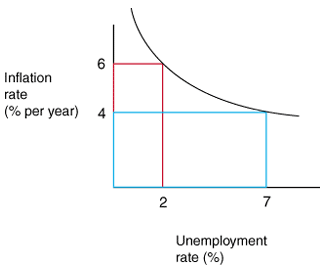
(the Philip's curve, from SparkNotes)
Many algorithmic problems show solutions with this feature, which is usually the tradeoff between runtime and memory. If you have very little extra room (little available data manipulation space) you might have to make many passed over the data than if you could just have another full copy of the data. One strategy is to build a big table (often in linear time) in comparison to an algorithm that uses only a couple registers and taking a long time to compute.
Or for a given technology, you want three things: quick production, low cost, and high quality, but any two of these means the third will be bad (see the CAP 'theorem' in distributed database design), you supposedly can only have two of the following, the third being prevented.
- Consistency (all nodes see the same data at the same time)
- Availability (a guarantee that every request receives a response about whether it succeeded or failed)
- Partition tolerance (the system continues to operate despite arbitrary partitioning due to network failures)
Supposedly in distributed systems you an only have two of these, because any two denies the third, where a single database on a single machine guarantees all three (the same as the ACID properties).
As rules of thumb, these are all interesting and useful observations to be made about a system. It gives you constraints so that that you shouldn't feel you have to worry about overcoming them.
But this is where design and cleverness come in. The space-time tradeoff or the pick any two of three restriction is just another hurdle to overcome. To solve a problem from the start, you used cleverness to solve it. But it has some drawbacks. In trying to remove the drawbacks, you introduce another drawback, and so you think there is an intimate relationship between the two drawbacks.
Don't stop there! Your next step of cleverness is to overcome both at the same time, and, as problems go, unless you can prove otherwise, there's no reason you can't make both good at the same time.
For example, take computing Fibonacci's number. F(n) = F(n-1) + F(n-2), F(1) = F(2) = 1.
The first answer is to use recursion and simply compute F(n--1) and F(n-2) directly. That has the drawback that, if left to do it all automatically in the recursion, F(n-k) is repeatedly computed many times.

(from UCR CS 141 course notes)
Notice there's lots of repeats.
Instead you can be clever and, once you notice how you compute it by hand, starting from F(3), using the known values F(1) and F(2).Then compute F(4) because you can now that you have F(3) and F(2) and similarly F(5) and so on till you reach F(n). That is linear time but takes linear space:

(from Archimedes Lab)
So we're stuck right, with a tradeoff between time and space, the faster the algorithm the more memory it will use?
Of course not. With all these 'rules', they are just patterns that may or may not follow. It's not necessary that there's a constraint.
For Fibonacci, another observation cuts through both. Instead of going from F(1) to F(n), computing every single item, you really only ever use 2 values at a time (the two previous ones). You don't need to maintain the entire previously computed values in the list. By judicious swapping (using a single temp variable), you can run through the entire table quickly without having to save the whole table, ratcheting upwards quickly.
And for two-out-of-three, there's the example of car manufacturing. Making a car by hand in the late 1800's early 1900's was a painstaking slow process, high cost, and questionable quality. But the assembly line process made all three better: produced cars much faster, much cheaper, and quality much better because every car was made the same way.
Note that with design there's also possibly a tradeoff with simplicity: the more constraints a design tries to handle, the less simple it tends to be. But as with the assembly line method, a simple design, all three are made better. There's no guarantee that more constraints means more complex.
Sure, sometimes the constraints are intertwined, one push must mean another gets pulled. But with appropriate design there may be away around it.
Saturday, August 15, 2015
There -are- realistic moon base plans
I was wrong. Lack of evidence is not evidence of lack.
I lamented the lack of moon base plans recently, but it was an error of not looking around enough.
Recently the European Space Agency got a new director, Johann-Dietrich Woerner, starting July 1.
But even before he started, he had stated his plans for what to do next on the way to other space plans
He states this in the context of ESA's targets after the ISS project finishes.
I can't tell yet how these plans relate to NASA's stated plans for manned mission to Mars.
I lamented the lack of moon base plans recently, but it was an error of not looking around enough.
Recently the European Space Agency got a new director, Johann-Dietrich Woerner, starting July 1.
But even before he started, he had stated his plans for what to do next on the way to other space plans
"the moon station can be an important stepping stone for any further exploration in deep space,"
He states this in the context of ESA's targets after the ISS project finishes.
"In any case, the space community should rapidly discuss post-ISS proposals inside and with the general public, to be prepared,"
I can't tell yet how these plans relate to NASA's stated plans for manned mission to Mars.
Friday, August 14, 2015
Turing and Kahneman believe wrong things! Sort of, not really.
Andrew Gelman in his blog post Turing and Kahneman and statistical evidence seem to trash the two giants. But really he isn't.
It looks like Alan Turing (AT) supports ESP:
It also looks like Daniel Kahneman (DK) supportsgeneral priming effects age-word priming on walking speed.
The two experts are really just aying that as far as they know, from the data, one might need to believe in implausible things. Science is filled with such implausibilities. Afterall, it doesn't feel like the Earth is turning, the Sun obviously is just moving across the sky. Things are complicated, you have to actually see additional data to be more accurate (Copernicus's model was not as accurate as Ptolemy's when first proposed).
It looks like Alan Turing (AT) supports ESP:
I assume that the reader is familiar with the idea of extra-sensory perception, and the meaning of the four items of it, viz. telepathy, clairvoyance, precognition and psycho-kinesis. These disturbing phenomena seem to deny all our usual scientific ideas. How we should like to discredit them! Unfortunately the statistical evidence, at least for telepathy, is overwhelming.And of course ESP is wrong! (By 'wrong' I mean of course that there's lots of evidence against it, despite AT's statement to the contrary).
It also looks like Daniel Kahneman (DK) supports
When I describe priming studies to audiences, the reaction is often disbelief . . . The idea you should focus on, however, is that disbelief is not an option. The results are not made up, nor are they statistical flukes. You have no choice but to accept that the major conclusions of these studies are true.But wait! To their defense! Priming in general is a well established phenomenon, just not in this particular instance. (it just turns out that the age-related priming on gait was a statistical fluke).
The two experts are really just aying that as far as they know, from the data, one might need to believe in implausible things. Science is filled with such implausibilities. Afterall, it doesn't feel like the Earth is turning, the Sun obviously is just moving across the sky. Things are complicated, you have to actually see additional data to be more accurate (Copernicus's model was not as accurate as Ptolemy's when first proposed).
Tuesday, August 11, 2015
My colonoscopy!
What really happens in a colonoscopy.
I went in for a 50-yr-olds screening colonoscopy. I got the usual medical euphemising in the patient education stuff they give you. Here is what really happens:
- you have a diet the week before ('low fiber' which means mostly food that's not usually considered healthy, no fruit or vegetables, yay BBQ and mashed potatoes!) and the night before (and morning of) you drink about a gallon (4 liters) of saline water (w/ PEG) in order to cause extreme emptying diarrhea (the good kind?) to clean your digestive tract of everything, everything, mostly poop. Nope, not mostly. All poop. You'll spend a lot of time on the toilet with a grumbling abdomen wondering if maybe you're gonna... oh... oh... just went. Don't try to judge if it's a fart or poop. It's gonna be poop. Drinking the prep is not bad at first, doesn't taste bad at all. Just nearing the finishing mark on the humongous jug, you just really don't want the next swallow, twice as worst as the last.
And then they put a tube up your butt.

(from UVA Health, there's a camera and light to see, and tool to cut off a polyp. How they get it back out for a pathology analysis I'm not sure, I don't see a grabber)
- The instructions and descriptions say things that are recognizably true from a technical point of view or afterwards (oh... that's what they meant) but are confusing, misleading, or incomprehensible without that experiential knowledge. So here goes for full disclosure:
- the process and procedure at the hospital I went to was frankly luxurious, I felt like I was at a Marriott. OK, I probably have low standards. You get a gown (that's the embarrassing butt-exposing one) and a robe (that's the one that makes you feel like a king even though it is essentially the same material and color as the gown just opens the other way. Full disclosure, I spent a lot of mental time trying to distinguish the gown and the robe, both the words and the objects. I agree with what the nurses claimed, that the prep was the words except for maybe putting the IV on my wrist (it hurt, and people kept coming up to shake my hand and I really didn't want to use that right hand). Oh also, I didn't care for the vital stats monitor which, though accurate (says I) on my blood O2 and pulse (both excellent!), gave me HBP (I don't think I was nervous about the procedure), and the respiratory rate monitor whose alarm kept going off as though I was inhaling at 6 times the normal rate. I believe the monitoring that makes me look good.
- the forgetting medication (Versed) really worked. Before the drug was administered, I vaguely remember the nurses all talking real fast, when giving me info or even small talk (so the drug was not retroactive, erasing events before ). At some point in the procedure room, I was laying on my side joking with the nurses. The joke was... dammit, I can't remember! was it about how I said I had practiced subtracting by 7 starting from a hundred and they said "oh, you won't have to do that", and I blinked and I was a bit woozy on my back with a nurse telling me it was all over I could go now. Presumably my hour in the recovery room after the procedure (I mean extremely invasive butt tube exploration) was already over. As an experiment, I had my son (who drove me back) ask me (I asked him before hand) three random words for me to try to recall later in the afternoon without internal repetition techniques. I remember asking him to tell me the words in the car. But later that afternoon, I could only remember one. I remember asking him to ask me this (on the drive back, and I also remember most of our conversation then). So essentially I remember most things about after I 'woke' up, except maybe a few details. I'm writing this only a couple hours afterwards (in case the forgetting drug is actually working and at some point the whole day will be erased (or never fully stored (or whatever the current metaphor is))
The words he came up with were 'big giant possum', and I could only come up with "the second word is 'big', the third word is weird, and the first is sort of boring like the second one". It seems strange that I wouldn't remember the one word that really stands out. Maybe it stood out that the first two words weren't weird (I know... weird right?) But for the most part, I am fairly confident I remember the car ride back home with him, telling him which lane to be in to be prepared for the exit, not this one but the next.
Anyway, the whole process is a great mix of low-tech and rocket science (drink salt water? camera on a tube? where brain surgery is all rocket science), and it saves peoples lives. If you have polyps, which are what become things that are cancer (technically: polyps are precursors to adenomatous neoplasms), then the polyps are removed, and that's that. You may have a predisposition to them, so you'll probably be scheduled for a follow-up colonoscopy much sooner if you have polyps (in three years rather than ten. But the magic (sorry, the science) is that it's sort of .. cured. Like skin cancer, if you remove it early (and that's the whole point of the colonoscopy), you're removing the cancer before it has spread so it is 'taken care of'.
I went in for a 50-yr-olds screening colonoscopy. I got the usual medical euphemising in the patient education stuff they give you. Here is what really happens:
- you have a diet the week before ('low fiber' which means mostly food that's not usually considered healthy, no fruit or vegetables, yay BBQ and mashed potatoes!) and the night before (and morning of) you drink about a gallon (4 liters) of saline water (w/ PEG) in order to cause extreme emptying diarrhea (the good kind?) to clean your digestive tract of everything, everything, mostly poop. Nope, not mostly. All poop. You'll spend a lot of time on the toilet with a grumbling abdomen wondering if maybe you're gonna... oh... oh... just went. Don't try to judge if it's a fart or poop. It's gonna be poop. Drinking the prep is not bad at first, doesn't taste bad at all. Just nearing the finishing mark on the humongous jug, you just really don't want the next swallow, twice as worst as the last.
And then they put a tube up your butt.

(from UVA Health, there's a camera and light to see, and tool to cut off a polyp. How they get it back out for a pathology analysis I'm not sure, I don't see a grabber)
- The instructions and descriptions say things that are recognizably true from a technical point of view or afterwards (oh... that's what they meant) but are confusing, misleading, or incomprehensible without that experiential knowledge. So here goes for full disclosure:
- the procedure is they put a long metal snakey tube up your butt, slowly, for about 6 feet (roughly the length of your large colon up to the cecal valve to the small intestine. The tube has a camera on the end to look for abnormal growths (polyps). If they find one, they have a tool at the end (next to the camera) to cut off or burn off he growth.
- the 'prep' is to clean out your intestines of shit. All those instructions are to make sure that you can get rid of any shit. When they say 'low fiber' in the diet and on food packages and all that? Fiber just means 'isn't digested' or more literally 'comes out in your poop'. You think your shit don't smell? You'll realize it does.
- Make sure you do the prep right. Because if there's shit in your colon, and the doc can't see the walls of your colon well, then they'll say 'fuck it, bad prep, I'm taking a smoke break' (ha ha, they don't take a smoke break, doctors as a whole don't smoke). And you have to do that prep all over again.
- But don't freak out about the prep. (I'm using the prep' for the few days of preparation by eating a low fiber diet and the gallon of liquid to drink the night before and morning of). Not eating, and only drinking the day before wasn't bad at all. I had jello for meals and italian ice for dessert. But you kind of forget about hunger. People would be polite and say 'Oh this pulled pork BBQ sandwich with hot sauce and a side of collard greens and butter smothered garlic mashed potatoes isn't very good." I knew it's great, but I can take a day off. Also, despite it not having a taste at all, you'll get a but sick of the liquid by about quart two. But that's why you take it in stages, half the night before and half the day of.
- the process and procedure at the hospital I went to was frankly luxurious, I felt like I was at a Marriott. OK, I probably have low standards. You get a gown (that's the embarrassing butt-exposing one) and a robe (that's the one that makes you feel like a king even though it is essentially the same material and color as the gown just opens the other way. Full disclosure, I spent a lot of mental time trying to distinguish the gown and the robe, both the words and the objects. I agree with what the nurses claimed, that the prep was the words except for maybe putting the IV on my wrist (it hurt, and people kept coming up to shake my hand and I really didn't want to use that right hand). Oh also, I didn't care for the vital stats monitor which, though accurate (says I) on my blood O2 and pulse (both excellent!), gave me HBP (I don't think I was nervous about the procedure), and the respiratory rate monitor whose alarm kept going off as though I was inhaling at 6 times the normal rate. I believe the monitoring that makes me look good.
- the forgetting medication (Versed) really worked. Before the drug was administered, I vaguely remember the nurses all talking real fast, when giving me info or even small talk (so the drug was not retroactive, erasing events before ). At some point in the procedure room, I was laying on my side joking with the nurses. The joke was... dammit, I can't remember! was it about how I said I had practiced subtracting by 7 starting from a hundred and they said "oh, you won't have to do that", and I blinked and I was a bit woozy on my back with a nurse telling me it was all over I could go now. Presumably my hour in the recovery room after the procedure (I mean extremely invasive butt tube exploration) was already over. As an experiment, I had my son (who drove me back) ask me (I asked him before hand) three random words for me to try to recall later in the afternoon without internal repetition techniques. I remember asking him to tell me the words in the car. But later that afternoon, I could only remember one. I remember asking him to ask me this (on the drive back, and I also remember most of our conversation then). So essentially I remember most things about after I 'woke' up, except maybe a few details. I'm writing this only a couple hours afterwards (in case the forgetting drug is actually working and at some point the whole day will be erased (or never fully stored (or whatever the current metaphor is))
The words he came up with were 'big giant possum', and I could only come up with "the second word is 'big', the third word is weird, and the first is sort of boring like the second one". It seems strange that I wouldn't remember the one word that really stands out. Maybe it stood out that the first two words weren't weird (I know... weird right?) But for the most part, I am fairly confident I remember the car ride back home with him, telling him which lane to be in to be prepared for the exit, not this one but the next.
Anyway, the whole process is a great mix of low-tech and rocket science (drink salt water? camera on a tube? where brain surgery is all rocket science), and it saves peoples lives. If you have polyps, which are what become things that are cancer (technically: polyps are precursors to adenomatous neoplasms), then the polyps are removed, and that's that. You may have a predisposition to them, so you'll probably be scheduled for a follow-up colonoscopy much sooner if you have polyps (in three years rather than ten. But the magic (sorry, the science) is that it's sort of .. cured. Like skin cancer, if you remove it early (and that's the whole point of the colonoscopy), you're removing the cancer before it has spread so it is 'taken care of'.
Monday, August 10, 2015
Women told 'just' not to use it.
Words have meanings but we don't always know how to say exactly what they mean. We can use words themselves, but using words o describe words is so much harder.
The latest in workplace advice, the difference between male and female speaking styles, says that there are a few key words that women should just not use.
The word is 'just'. Women tend to use it more than men. And they are advised that using it makes them look weak. Not confident.
I'm here to mansplain that they're doing it wrong. That they're explaining the use of the word wrong. They have a point, that 'just' is a kind of 'weasel' word, one that weakens impact, that deflects confrontation, that pulls its punches, that
It's just that in my testosterone fueled autistic-spectrum inspired pedanticism, I must point out (as opposed to 'I just want to say') exactly which kind of 'just' is weak mousy wall-flower, and which is the manly man's cudgel.
Some examples
- I just wanted to ask you
Weasel. Just ask. Ha ha. 'Ask'. No that doesn't sound as good. 'Just ask' is just the right thing. Argh. Is the right thing.
- I just finished the report
Not weasel. It's more precise timing. 'I finished is not precise'. Of course you probably should have finished it at 3am, not last night because that shows procrastination, but 2 weeks ago because that shows you will work non-stop.
- I just happened to notice you've been coming in later.
Weasel ('happened to' is somewhat weak too). Say "I noticed you've been...". No, say 'You've been...". No. Say "Come in earlier". Oh, this is to your boss? Say "You've been working so hard lately".
- I just came by to ...
Weasel. This is classic weak deflection. I agree that this is not confident. For this I think they are right. Use "I'd like to talk to you about..." not too intrusive but not so easy to dismiss (nobody wants to be annoyingly interruptive, but sometimes you have to).
- I know just where those files are.
Not weasel. Means 'exactly'. Perfectly appropriate. Be confident and stick with this usage instead of blindly removing all uses of 'just'.
- I am just trying to relay this information to you.
Weasel. Translated "I don't have enough time to explain. Take your hand out of the blender before you turn it on".
- A just tuning does not allow the freedom of changing key as a well-tempered one
Not weasel. This is a technical term in music. I had to throw that one in. Words are complicated.
- Just a minute.
Weasel. Instead use "No, Thursday's out. How about never - is never good for you?"
- My decision to fire half our firemen was well thought out and just.
Not weasel. No one thinks this is a bad use of ;just' (except for the firemen). I just wanted... grits teeth)... I want to give an example of where blind elimination is catching perfectly strong uses. 'Just' as a synonym of 'fair' is slightly manly because it comes from 'justice' even though an eye-for-an eye is a little more macho.
And since we're thinking of false positives and false negatives, why aren't dudes just told to use 'just' more?
Executive summary: don't use 'just' as an adverb, all other uses are fine. Or just use it all you want and embrace cooperation and nuance.
Examples of bad^H^H^Hfemale^H^H^H^H^H^Hdeprecated usage from "Just" say no:
"I just wanted to check in on …"
"Just wondering if you'd decided between …"
"If you can just give me an answer, then …"
"I'm just following up on …"
Friday, August 7, 2015
What is wrong, terribly wrong, with wordles
I love wordles! They're so cool, like making artwork out of a big long text that I don't want to bother reading! I can see what's really important in a text by what's most common! And I get that in a flash!
I can't stand wordles. They're so mindless and dumbing down. Any good text will have a variety of vocabulary. frequency is misleading, texts are not just dumb bags of words.
These are extremely tendentious. I believe them both. But what I'll explain is what is problematic with them as data visualization.
What's a wordle? Also known as a tag cloud or word cloud, it's a graphic design method that takes a document, determines the frequencies of the unique words in that document, and mooshes the text of the words into an image, some vertical, the size of the word text in proportion to its frequency in the document. So from some document we get the dry list of individual word frequencies:
Wordle 127
word 35
words 30
cloud 28
students 22
clouds 22
Day 18
lessons 12
fused 12
adjectives 6
historical 5
classroom 5
even 4
see 4
...
This can be converted into a barchart:

which is the Zipf curve of the document.
Now comes the cool graphic the wordle. instead of boring bars, make the word itself and its size tell you how important it is. Mushing them all together and letting the natural instinct of readability draw your eye to what's important:

But what is the point of a wordle and how successful is it for what ever points it might have?
If the point is that it is a piece of art, then I've made a case for it already. A new wordle for each new document is a bit derivative though, with too many barely distinguishable varieties. One here or there is great, but a number of them is numbing.
How is it as a data visualization? How well does it relate the data?
The ostensible purpose of a wordle is to show you the relative frequency of words in a document. What is actually done is to show you the obvious top two or three most frequent words. All other words are essentially ignored.
That may very well be the best part of the wordle, that it presents essential information (the two or three most frequent) in an esthetically pleasing manner. The size of a word pulls your eye towards it because it is easier to read, and if it is readable, there's no unreading it (it forces its meaning on you).
- the eye is encouraged to dance around. this may account for the esthetics, but it is an annoyance for comparison.
- Vertical presentation of a word almost guarantees that you can't read it.
- comparison of size is even more difficult than a pie chart. two words not even exactly next to each other are difficult to compare (the word length itself is not the frequency but it accounts for the relative noticeability.
So really the information that can be pulled out of a wordle is: the most frequent word (which does usually outweigh all others in most documents), the second and third most frequent, but you're not sure which is which, and maybe one or two in the top ten but maybe you missed some.
Under this analysis, this is a Type V error in Fung's Visualization Trifecta Checkup, where the data and questions are well defined, but the visualization (the V) just isn't right.
So instead of complaining, what would be a better method, one that would actually address the stated purpose of showing relative frequencies?
The simplest (and least graphically pleasing) is the source list of stats: a text list, one word per line followed by its count in the document. Because numbers themselves are hard to judge easily in a list (but lengths are), maybe using a barchart sorted by frequency, and then maybe cut off at about 10 or so. The screen space taken up by the frequency list is about the same as the wordle image itself and allows extraction of a lot more information. All the information is in this list, and it is all readable, and all comparisons can be made very easily. Surely there are frequency questions that can be asked that are not easily answered by the list, but what might be slightly difficult for the list is impossible for the wordle.
What this says is that wordles are really good at showing you the top couple of words in an esthetically pleasing manner; what it puts in your head is mostly 'X is the most common, and Y is maybe a little less common' and thats the extent of its specificity.
But if you want to know even minimally less vague comparisons, and more than 2 words, a wordle does not do it that well.
Or to put it more bluntly, a wordle is popular because it is beautiful, not true.
TL;DR: A wordle is estheticaly pleasing but is not even as good as a piechart for transmitting information.
Monday, July 20, 2015
Deep Learning is not Magic Learning
Any sufficiently advanced technology is indistinguishable from magic. Arthur C Clarke
"Deep Learning is Teaching Computers New Tricks"
"Andrew Ng: Why 'Deep Learning' Is a Mandate for Humans"
Holy crap! Use Deep Learning to create new ideas? You may be thinking that I'm being too harsh; of course article and title writers stretch things out to be more provocative, details left to the gross middle of the article that no one reads. Well, then, yes, I'm being too harsh, not because the details are left out, but because their implications of the details are ignored.
Deep learning is not Magic Learning. Deep Learning isn't what its name says. It is 'just' a more complex (= many more layers than traditional) neural network (which is itself not exactly what its name say, it is 'just' a set (OK I'll grant network) of linear regression models, where some depend on others. It's not magic. It's not human like learning or deep cogitation on concepts. It is just a mathematical model. It can distinguish two almost identical things. It can identify one thing out of many. But that's the all that the technique itself does (just the best in a long line of similar techniques). It (like many other techniques: logistic regression, decision trees, random forests (ooh..they're magical! Their names are so exotic!) needs to be put in a larger framework (like in a process that determines the outlines of faces in a set of cat pictures, or splitting words n a speech to text analyzer). By themselves, there's nothing magical.
This is not to say that there's something wrong with Deep Learning. On the contrary, it is a great recent development, with lots of successes (which is exactly what happened to its simpler self in the late 80's). But in the end it is 'just' a regression model, either saying yes or no to some inputs, or calculating a complex function. But that's it. It is not 'an' artificial intelligence, responding and implementing our requests like a valet. It's just (one of the more) recent advances in discrimination methods. It is an important part of the field of artificial intelligence, but not the entire thing.
Is extracting 100's of initial petroleum products (fuel, plastics, lubricants, medications, etc) magic? not to mention 1000's of downstream products created from manipulation of these?
Frankly Siri is closer to magic because at least 40 years of electrical engineers and phoneticians have worked on converting sound waves produced by a humans oral and nasal cavity, modulated by teeth and tongue, into readable letters.
Deep Learning is not magic. They are a great development in neural networks (an incremental development (a very big incremental development)), but they're not magic and they won't make you your toast for you in the morning.
(this morphed from the inarticulate unfinished beginning of a rant I had planned about ML (Machine Learning). And NLP (Natural Language Processing (not Neuro-Linguistic Programming which actually is horseshit))).
Sunday, June 21, 2015
"You don't see people casually become neurosurgeons in their spare time"
From James Hague, Organizational Skills Beat Algorithmic Wizardry via John Cook, The most important skill in software
Yeah, why is it that so many professional programmers are self-taught? So a brain surgeon is the top of the charts, but even a family practice doctor, the front line of medicine, still has the education and training of a rocket scientist.
So that's a bit tantalizing 'This is the reason...'. But Hague doesn't really give a reason. OK he sorta does. Previously he says:
It seems that Hague is saying that 'refactoring well' is the key to successful programming, not algorithmic wizardry. Historically, programming was algorithmic wizardry (a la CLRS) because that's what computers were good for, calculating extremely difficult mathematical or combinatorial computations. What is the shortest path that visits all nodes in this special graph? (greedy just doesn't work) How do you solve for a vector in a matrix equation using Gaussian elimination without using extra space? (space was at a premium). Those tasks needed wizardry, the kind of thought that goes into solving a Rubik's Cube, having good memory for a few examples, seeing patterns in them, seeing in the patterns, always an eye for optimization.

How do you get that one yellow orange edge piece in place without messing everything else up? Figuring that out takes a lot of 3D imagination ability, a lot of memory, and a lot of trial and error, but eventually you come up with a set pattern to follow like "U' L' U L U F U' F'" (ha ha that's technical, and not doable without, but that's what algorithms are). But once you have the pattern, it's straightforward to compose with other patterns (which you have to figure out possibly totally different from the patterns for the above or maybe somewhat similar)
But nowadays it seems lots of those difficult algorithms have been solved. They're in a library. You don't have to reimplement red-black trees to create a database index, you use the library. Programming today is more like 'Rush Hour', where you're moving a small set of pieces, some blocking others, but maybe the first are blocking the latter and you have to plan ahead.

You're rearranging a bunch of pieces to make the whole thing come out. For a webapp, you need some forms on the front end, communicating via http calls to a backend with a database, but your webapp needs to run on a smart phone and a tablet, too. All straightforward large pieces, but to make sure that you make it easier for yourself to modify later, you want to separate the pieces well.
What makes a good programmer, and allows so many without academic education in it to perform well, is that this kind of large piece thinking is usually amenable to anybody with a technical background, engineering, math, science. Most of such fields promote detail-oriented, symbolic thinking and memory (all of which is good to grasp the computational nature of programming) but also the
So the answer to the original question? Not everybody is an algorithms wizard, can figure out Rubik's cube, there's lots of special talent needed for that. But most technically oriented people, without specific experience, can program nowadays, can solve Rush Hour problems. It's not easy (especially for the more difficult layouts), but most technically oriented people can plow through it. You don't need to know linear algebra to do a website, you just need to read a few docs in order to move a handful of pieces around.
This is the reason there are so many accidental programmers. You don't see people casually become neurosurgeons in their spare time--the necessary training is specific and intense--but lots of people pick up enough coding skills to build things on their own.
Yeah, why is it that so many professional programmers are self-taught? So a brain surgeon is the top of the charts, but even a family practice doctor, the front line of medicine, still has the education and training of a rocket scientist.
So that's a bit tantalizing 'This is the reason...'. But Hague doesn't really give a reason. OK he sorta does. Previously he says:
To a great extent the act of coding is one of organization [not algorithmic wizardry]. Refactoring. Simplifying. Figuring out how to remove extraneous manipulations here and there.Except programmers don't get hired because they show how well they can reorganize things, but by how they write an algorithm (classic interview questions). Sure, I bet there are some refactoring questions in some places (and I think those are just as useful a measure as the algorithm questions). But what gets you hired is your knowledge of the syntax of a programming language and maybe its libraries. But that's interviews and hiring.
It seems that Hague is saying that 'refactoring well' is the key to successful programming, not algorithmic wizardry. Historically, programming was algorithmic wizardry (a la CLRS) because that's what computers were good for, calculating extremely difficult mathematical or combinatorial computations. What is the shortest path that visits all nodes in this special graph? (greedy just doesn't work) How do you solve for a vector in a matrix equation using Gaussian elimination without using extra space? (space was at a premium). Those tasks needed wizardry, the kind of thought that goes into solving a Rubik's Cube, having good memory for a few examples, seeing patterns in them, seeing in the patterns, always an eye for optimization.
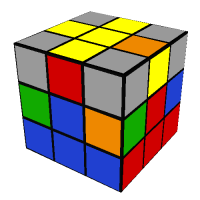
How do you get that one yellow orange edge piece in place without messing everything else up? Figuring that out takes a lot of 3D imagination ability, a lot of memory, and a lot of trial and error, but eventually you come up with a set pattern to follow like "U' L' U L U F U' F'" (ha ha that's technical, and not doable without, but that's what algorithms are). But once you have the pattern, it's straightforward to compose with other patterns (which you have to figure out possibly totally different from the patterns for the above or maybe somewhat similar)
But nowadays it seems lots of those difficult algorithms have been solved. They're in a library. You don't have to reimplement red-black trees to create a database index, you use the library. Programming today is more like 'Rush Hour', where you're moving a small set of pieces, some blocking others, but maybe the first are blocking the latter and you have to plan ahead.
You're rearranging a bunch of pieces to make the whole thing come out. For a webapp, you need some forms on the front end, communicating via http calls to a backend with a database, but your webapp needs to run on a smart phone and a tablet, too. All straightforward large pieces, but to make sure that you make it easier for yourself to modify later, you want to separate the pieces well.
What makes a good programmer, and allows so many without academic education in it to perform well, is that this kind of large piece thinking is usually amenable to anybody with a technical background, engineering, math, science. Most of such fields promote detail-oriented, symbolic thinking and memory (all of which is good to grasp the computational nature of programming) but also the
So the answer to the original question? Not everybody is an algorithms wizard, can figure out Rubik's cube, there's lots of special talent needed for that. But most technically oriented people, without specific experience, can program nowadays, can solve Rush Hour problems. It's not easy (especially for the more difficult layouts), but most technically oriented people can plow through it. You don't need to know linear algebra to do a website, you just need to read a few docs in order to move a handful of pieces around.
Thursday, June 18, 2015
The term 'Big Data' now means 'More Data Than You Thought Of Before'
What is 'Big Data'? For the past few years (let's say roughly 5, before which it was not nearly as popular as after) everybody knows what it means. It's a bunch of data and there's a lot of it. Also machine learning and FitBit. The term has come to mean many things. It was originally coined.. well.. it's sorta vague. And its current usage (how it is used by people) is not the same as its intended definition.
First, what is it supposed to be now? Wikipedia gives the following:
Conveniently a source search for the provenance of the term has been done: who first used it in a similar way to what it means now.
And Forbes gave a list of many possible definitions, some more substantive than others. These are all definitions I can agree with. There's data, it's structured in weird new ways, and it comes from new sources that produce gobs and gobs of it. The term 'Big Data' is used to contrast with traditional data, its storage and techniques. Traditional data is not 'Big' and therefore is 'small' and its techniques are 'old'. I'd say any kind of relational database (SQL related) is traditional.
Big data is things like mouse clicks or even mouse movements on a screen, or fitbit near continuous polling of heart rate and blood O2 (does it really do that? I don't know!). Or road sensors checking car presence on a road or at a stop light. Every possible transaction, position.
The thing is that what a lot of people are calling 'Big Data' are really pretty traditional. For example, what about credit card transactions, is that big? They're constantly checking them for out of the ordinary purchases so that they can cut off my service right when I need it at an airport. Or tax returns? There must be millions, and for even the simplest return, hundreds of entries and calculations! Or weather sensors for near continuous temp/pressure/precip/windspeed? These are old data sources, no one would call them Big Data, they have been around long enough that they -are- traditional. Yet they are all at the forefront of large and complex systems design.
And then there are the false positives, those things that are called big data but don't really fit that definition. For example, electronic health records collect a lot of information on a patient. But... it's about as traditional as traditional gets. Straightforward collection of forms or transcripts or lists of entries.
I am purposefully leaving out things like EKGs or radiological images, not because they deny my point but because they are the exception that proves the rule. They both take of gobs and gobs of space (for radiology a single CT scan of the body can take up X Gig. In the best sense, the data 'size' of a study is 1, or rather it is the size of the radiologist's text report describing the results found in the images ('Insignificant thyroidal calcification. No other findings') that counts, and that hardly counts. The scale is pretty small.
So what is not Big Data that actually isn't Big Data (by the official definition)? There's the database of clients that one company manages, all the contact information, the account transactions. Classic relational database. There's the auto parts store with its database of suppliers and buyers, all the various parts for sale with their characteristics and which make/model/year they work with, the list of sales and inventory. Classic relational database.
Also, the term 'Big Data' has a particularly ... millenial 'kids-these-days' feel to it. It is a bit inarticulate in that it's not saying exactly what it is, but everyone has a good idea of what they think it should mean. 'Big' is about as meaningful as 'wow'.
Anyway, 'Big Data' ... I'll use it for what everybody else uses it for (I don't know what that is yet !), both big new things, and also smaller traditional things that most people never really thought about before.
Footnote: this is entirely patterned after the term 'superccomputer' which has a similar history. In the late 70's Cray I was a supercomputer, and today (mid 2010's) a smart phone is just a little ... thing, despite the fact that the smart phone computes more flops than the Cray. A supercomputer is pretty much just the best possible computer in existence -right now-.
First, what is it supposed to be now? Wikipedia gives the following:
Big data is a broad term for data sets so large or complex that traditional data processing applications are inadequate
Conveniently a source search for the provenance of the term has been done: who first used it in a similar way to what it means now.
And Forbes gave a list of many possible definitions, some more substantive than others. These are all definitions I can agree with. There's data, it's structured in weird new ways, and it comes from new sources that produce gobs and gobs of it. The term 'Big Data' is used to contrast with traditional data, its storage and techniques. Traditional data is not 'Big' and therefore is 'small' and its techniques are 'old'. I'd say any kind of relational database (SQL related) is traditional.
Big data is things like mouse clicks or even mouse movements on a screen, or fitbit near continuous polling of heart rate and blood O2 (does it really do that? I don't know!). Or road sensors checking car presence on a road or at a stop light. Every possible transaction, position.
The thing is that what a lot of people are calling 'Big Data' are really pretty traditional. For example, what about credit card transactions, is that big? They're constantly checking them for out of the ordinary purchases so that they can cut off my service right when I need it at an airport. Or tax returns? There must be millions, and for even the simplest return, hundreds of entries and calculations! Or weather sensors for near continuous temp/pressure/precip/windspeed? These are old data sources, no one would call them Big Data, they have been around long enough that they -are- traditional. Yet they are all at the forefront of large and complex systems design.
And then there are the false positives, those things that are called big data but don't really fit that definition. For example, electronic health records collect a lot of information on a patient. But... it's about as traditional as traditional gets. Straightforward collection of forms or transcripts or lists of entries.
I am purposefully leaving out things like EKGs or radiological images, not because they deny my point but because they are the exception that proves the rule. They both take of gobs and gobs of space (for radiology a single CT scan of the body can take up X Gig. In the best sense, the data 'size' of a study is 1, or rather it is the size of the radiologist's text report describing the results found in the images ('Insignificant thyroidal calcification. No other findings') that counts, and that hardly counts. The scale is pretty small.
So what is not Big Data that actually isn't Big Data (by the official definition)? There's the database of clients that one company manages, all the contact information, the account transactions. Classic relational database. There's the auto parts store with its database of suppliers and buyers, all the various parts for sale with their characteristics and which make/model/year they work with, the list of sales and inventory. Classic relational database.
Also, the term 'Big Data' has a particularly ... millenial 'kids-these-days' feel to it. It is a bit inarticulate in that it's not saying exactly what it is, but everyone has a good idea of what they think it should mean. 'Big' is about as meaningful as 'wow'.
Anyway, 'Big Data' ... I'll use it for what everybody else uses it for (I don't know what that is yet !), both big new things, and also smaller traditional things that most people never really thought about before.
Footnote: this is entirely patterned after the term 'superccomputer' which has a similar history. In the late 70's Cray I was a supercomputer, and today (mid 2010's) a smart phone is just a little ... thing, despite the fact that the smart phone computes more flops than the Cray. A supercomputer is pretty much just the best possible computer in existence -right now-.
Tuesday, June 16, 2015
SWOT Analysis of SWOT Analysis
Where is this company going? Who are our competitors? How do we increase market penetration?
SWOT analysis, a diagram listing Strengths, Weaknesses, Opportunities, and Threats, is a great high level management strategy tool in business. It doesn't tell you what to do when there's a problem, it just helps you describe a situation.
It forces you to make explicit both good and bad, and the internal and external features of your situation. As a graphic model, it puts like things in the same place and gives a well-defined, limited structured place to put them. You can use it for the highest level (for an entire company) or for a very low level (one particular product), or even for the most technical of things (should I learn a particular technical skill?). It's not for everything and it doesn't do everything for the things it is for.
Here's a template of a SWOT analysis chart with the kinds of questions that go in each:

(from http://www.conceptdraw.com/How-To-Guide/swot-analysis-matrix-template)
There are two axes, either internal or external, and the quality either good or bad. It's probably bad form to mention the negative of an item from the positive side, sort of non-creative and redundant. Threats can be competitors, but it may also be useful to do an entire SWOT on a competitor for true comparison sake.
There are many examples and explanations of SWOT analysis. Here's a simple example for a bank:

(from http://www.theasianbanker.com/benchmarking/our-tools)
Unfortunately, I couldn't find any examples of real SWOTs (from the real world), so a made up academic example will have to do.
So now the point of this is to judge SWOT by some judgement method. Since SWOT analysis is exactly one of those methods, let's turn it on itself. I (and other sites) have given a wordy analysis, so I'll just give the SWOT analysis as is without any additional commentary.
Internalities
Strengths
- well-defined, simple structure, limits issues to judge
- simple to understand
- quick to complete, low cost
- makes explicit for all ideas of things to do (externalities) and how well you can expect to do them (internals)
- doesn't need too much knowledge of the company to create details
Weaknesses
- no ranking of importance of items
- too superficial, oversimplification of issues, shallow
- many details left out, lots of context left out
- not operational, doesn't help with figuring out what to do
- only binary, hard to include important but multifaceted issues
- balance implied but not necessary
Externalities
Opportunities
- many people don't know of this method
- lo-tech, doesn't need (computer) tools to fill out
- can be used for non-business situations
Threats
- there are many other forms of business analysis (Gannt charts, weighted average, competency chart)
- easily overlooked because so shallow
- results often overlooked, swamped by other methods
So there's not much that can be said reasonably about opportunities or threats here. SWOT is an analysis method, not a startup. So I guess that's another weakness of SWOT, that it's not applicable in more contexts. Externalities are mostly relevant in gaming situations where there are true competitors vying for resources (like in a business situation). Opportunities and threats seem geared almost directly to a sales or niche competition (greenfield vs brownfield, red ocean vs blue), how to use one's strengths to pursue an opportunity.
One thing missing from this analysis of analysis, which doesn't fit in the restrictions of this analysis, is the range of competitors. It's a detail mentioned but not made explicit. I feel like it would be a great lack if those details aren't mentioned here even though it doesn't fit within the constraints of the academic problem.
The competitors, or rather alternatives to SWOT analysis are:
- TOWS - builds on top of SWOT, pairs of SWOT quadrants
- SOAR - the positive version of SWOT, Strengths, Opportunities, Aspirations and Results
- Growth Share Matrix - scatter plot of businesses by market share vs growth rate
- Gap Analysis - comparison of actual with potential performance
Surely there are other more substantive alternatives to SWOT?
SWOT analysis, a diagram listing Strengths, Weaknesses, Opportunities, and Threats, is a great high level management strategy tool in business. It doesn't tell you what to do when there's a problem, it just helps you describe a situation.
It forces you to make explicit both good and bad, and the internal and external features of your situation. As a graphic model, it puts like things in the same place and gives a well-defined, limited structured place to put them. You can use it for the highest level (for an entire company) or for a very low level (one particular product), or even for the most technical of things (should I learn a particular technical skill?). It's not for everything and it doesn't do everything for the things it is for.
Here's a template of a SWOT analysis chart with the kinds of questions that go in each:
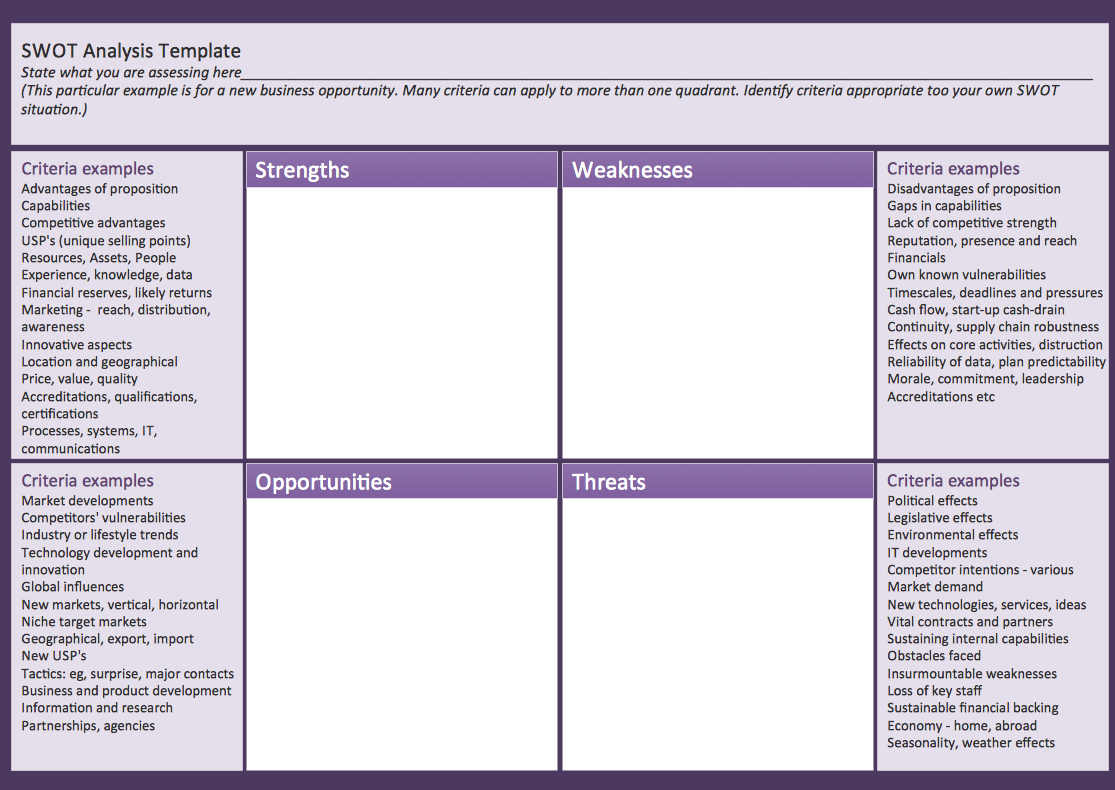
(from http://www.conceptdraw.com/How-To-Guide/swot-analysis-matrix-template)
There are two axes, either internal or external, and the quality either good or bad. It's probably bad form to mention the negative of an item from the positive side, sort of non-creative and redundant. Threats can be competitors, but it may also be useful to do an entire SWOT on a competitor for true comparison sake.
There are many examples and explanations of SWOT analysis. Here's a simple example for a bank:

(from http://www.theasianbanker.com/benchmarking/our-tools)
Unfortunately, I couldn't find any examples of real SWOTs (from the real world), so a made up academic example will have to do.
So now the point of this is to judge SWOT by some judgement method. Since SWOT analysis is exactly one of those methods, let's turn it on itself. I (and other sites) have given a wordy analysis, so I'll just give the SWOT analysis as is without any additional commentary.
Internalities
Strengths
- well-defined, simple structure, limits issues to judge
- simple to understand
- quick to complete, low cost
- makes explicit for all ideas of things to do (externalities) and how well you can expect to do them (internals)
- doesn't need too much knowledge of the company to create details
Weaknesses
- no ranking of importance of items
- too superficial, oversimplification of issues, shallow
- many details left out, lots of context left out
- not operational, doesn't help with figuring out what to do
- only binary, hard to include important but multifaceted issues
- balance implied but not necessary
Externalities
Opportunities
- many people don't know of this method
- lo-tech, doesn't need (computer) tools to fill out
- can be used for non-business situations
Threats
- there are many other forms of business analysis (Gannt charts, weighted average, competency chart)
- easily overlooked because so shallow
- results often overlooked, swamped by other methods
So there's not much that can be said reasonably about opportunities or threats here. SWOT is an analysis method, not a startup. So I guess that's another weakness of SWOT, that it's not applicable in more contexts. Externalities are mostly relevant in gaming situations where there are true competitors vying for resources (like in a business situation). Opportunities and threats seem geared almost directly to a sales or niche competition (greenfield vs brownfield, red ocean vs blue), how to use one's strengths to pursue an opportunity.
One thing missing from this analysis of analysis, which doesn't fit in the restrictions of this analysis, is the range of competitors. It's a detail mentioned but not made explicit. I feel like it would be a great lack if those details aren't mentioned here even though it doesn't fit within the constraints of the academic problem.
The competitors, or rather alternatives to SWOT analysis are:
- TOWS - builds on top of SWOT, pairs of SWOT quadrants
- SOAR - the positive version of SWOT, Strengths, Opportunities, Aspirations and Results
- Growth Share Matrix - scatter plot of businesses by market share vs growth rate
- Gap Analysis - comparison of actual with potential performance
Surely there are other more substantive alternatives to SWOT?
Tuesday, June 9, 2015
Why are there no moon base plans?
The current space obsession is a manned mission to Mars. In the past couple of years there's been all sorts of stories and books on how to to do it, what the purpose of such a mission is, the difficulties, the variations.
Every president since Bush Sr (wait did Obama mention it?) has promised to put a man on mars (wait, did -Clinton do it?).
It seems like these big media plans are almost as common as plans to create a high speed rail line between NYC and Washington (or San Francisco and LA, or Chicago and St. Louis). Every new governor
I'm all gung ho for every sci-fi inspired space plan: mining asteroids for precious resources, terraforming Ganymede for farming, solar sails to travel among the planets.
But.. this should be sci-fi inspired engineering, not science fantasy. Wouldn't it be more cost effective and profitable and room for learning more about engineering around off-earth environments if we went incrementally? There is a space station, a bit smallish, with worldwide support. Shouldn't there be some intermediary step, like a moon base?
First, an efficient transport mechanism to a low orbit space station, via rockets or space elevator or what have you.
Then maybe an intermediate high orbit one.
Then a minimal lunar base.
Then lunar L1 and L2 satellite stations.
Then an expanded lunar base.
...and a whole bunch of intermediary supply chain steps, not just to support a permanent connection (realistically, we don't know if we'l be able to support that in the long term), but to support exploitation of those intermediate steps as ends to themselves.
Then, once all that's done, a visit to Mars (because all those previous items will make the trip that much easier. Don't blow a shitload of money on a one-off to Mars. Make it realistically attainable.
Also, in parallel (and maybe with more money than carved out for a manned mission), that much more robotic exploration. Let the machines die first. It's less expensive and less upsetting and demoralizing.
Oh. I'm sorry. There -are- plans for a moon base.. But I have no idea if this is part of a grand plan.
Also, what's the business plan other than 'Holy shit this will be cool'? (I'm all for that business plan, but my funding is in science fiction dollars)
Ioannidis' "Why Most Published Research Findings Are False" - two kinds of 'false'
Ioannidis put out "Why Most Published Research Findings Are False" 10 years ago.
The title is provocative. False? Really? Oh my god, are bridges falling? (no). But are people having adverse reactions to this medication that doesn't really do anything? Very probably!
But really, what did Ioannidis mean by 'false'? Most people think of 'false' as the entire opposite of 'true' (well, there's very little denying that!) But what I mean is rather 'false' means that the entire opposite of a statement is true. And that subtlety makes a difference.
"This apple is red"... that is either true or false. It may be entirely green, in which case that statement is perfectly false. Or it may be mostly red with green spots. Or it may be partly green and partly red about the same area. Or maybe it is about to turn from green to red and is paradoxically half way between. You can judge for yourself how true or false each of those might be. But there is undoubtedly play or vagueness in those words, in 'red' and 'false, maybe even 'is'.
When it comes to experiments, the situation is now about a number of things. 'All apples are red'. That is certainly not the case, because some are green. If there is at least one apple that is not red, then that statement is false (not only be everyday common sense, but by the stipulated mathematical/logical usage of quantifiers like 'all'. But scientifically 'all apples are red' can be statistically justified (and it is accepted usage) if there are a reasonable few that aren't red. That is, 'All apples are red, except for a few which don't really count'.
But that is my semantic analysis. It is totally relevant to modern research, and gives a reasonable interpretation to the title of the paper. Most experimental research is trying to say something like "All X are Y, for the most part". Ioannidis in his paper is actually pursuing another definition of false. Sorry, not another definition, but a perfectly good, oops the best, most correct definition of false... in a particular context. Well, in the interests of full disclosure, he uses it two ways, in the traditional definit... oops context, and then also in a computational context.
How he uses 'false' this is not terribly complex and is very logical and supportable and I agree with it and it is a useful way of using 'false'... but it's not what you expect. He takes the usual 2x2 statistical hypothesis testing paradigm with its type I and type II errors ("Apples are mostly red" vs "Apples are not mostly red (a non-negligeable amount are not red" as competing hypotheses and then testing against reality).
What Ioannidis does is take the parameters for hypothesis testing, alpha the probability of a false negative, beta the probability of a false positive (this is also the parameter for determining power, or the number of instances required to guarantee a significant result if there is one), and R the prior probability of the hypothesis being true, and computes the PPV (positive predictive value), using very elementary and straightforward arithmetic (see Table 1)

The PPV is TP/(TP+FP) = (1-beta)R/(R+alpha-beta*R). OK that's not 2+2, but it's not at all rocket science. He simplifies this considerably by setting alpha to be the usual cutoff for significance acceptability:

Presumably, He considers only those top two to be generally true, and all the rest presumably false (the latter even in the loosey goosey/benefit of the doubt/non-categorical/for the most part 'true').
The press for this article often claims that Ioannidis says that '75% of studies are false'. Again, presumably, that figure comes from a some weighted average, over all studies (in some unspecified context) using the above table. I have not done that computation, nor the setup work of judging a large set of studies (medical?) and which category they lie in.
The title is provocative. False? Really? Oh my god, are bridges falling? (no). But are people having adverse reactions to this medication that doesn't really do anything? Very probably!
But really, what did Ioannidis mean by 'false'? Most people think of 'false' as the entire opposite of 'true' (well, there's very little denying that!) But what I mean is rather 'false' means that the entire opposite of a statement is true. And that subtlety makes a difference.
"This apple is red"... that is either true or false. It may be entirely green, in which case that statement is perfectly false. Or it may be mostly red with green spots. Or it may be partly green and partly red about the same area. Or maybe it is about to turn from green to red and is paradoxically half way between. You can judge for yourself how true or false each of those might be. But there is undoubtedly play or vagueness in those words, in 'red' and 'false, maybe even 'is'.
When it comes to experiments, the situation is now about a number of things. 'All apples are red'. That is certainly not the case, because some are green. If there is at least one apple that is not red, then that statement is false (not only be everyday common sense, but by the stipulated mathematical/logical usage of quantifiers like 'all'. But scientifically 'all apples are red' can be statistically justified (and it is accepted usage) if there are a reasonable few that aren't red. That is, 'All apples are red, except for a few which don't really count'.
But that is my semantic analysis. It is totally relevant to modern research, and gives a reasonable interpretation to the title of the paper. Most experimental research is trying to say something like "All X are Y, for the most part". Ioannidis in his paper is actually pursuing another definition of false. Sorry, not another definition, but a perfectly good, oops the best, most correct definition of false... in a particular context. Well, in the interests of full disclosure, he uses it two ways, in the traditional definit... oops context, and then also in a computational context.
How he uses 'false' this is not terribly complex and is very logical and supportable and I agree with it and it is a useful way of using 'false'... but it's not what you expect. He takes the usual 2x2 statistical hypothesis testing paradigm with its type I and type II errors ("Apples are mostly red" vs "Apples are not mostly red (a non-negligeable amount are not red" as competing hypotheses and then testing against reality).
What Ioannidis does is take the parameters for hypothesis testing, alpha the probability of a false negative, beta the probability of a false positive (this is also the parameter for determining power, or the number of instances required to guarantee a significant result if there is one), and R the prior probability of the hypothesis being true, and computes the PPV (positive predictive value), using very elementary and straightforward arithmetic (see Table 1)
The PPV is TP/(TP+FP) = (1-beta)R/(R+alpha-beta*R). OK that's not 2+2, but it's not at all rocket science. He simplifies this considerably by setting alpha to be the usual cutoff for significance acceptability:
Since usually the vast majority of investigators depend on a = 0.05, this means that a research finding is more likely true than false if (1 - β)R > 0.05.He then goes to show in a later table 4, that for given beta and R (and bias u) that, given a few types of studies, studies in each type having roughly the same params, each kind of study will have a probability of being ... true (statistically/roughly/acceptably).
Presumably, He considers only those top two to be generally true, and all the rest presumably false (the latter even in the loosey goosey/benefit of the doubt/non-categorical/for the most part 'true').
The press for this article often claims that Ioannidis says that '75% of studies are false'. Again, presumably, that figure comes from a some weighted average, over all studies (in some unspecified context) using the above table. I have not done that computation, nor the setup work of judging a large set of studies (medical?) and which category they lie in.
Friday, June 5, 2015
Precision != Precision, or Measurement, Categorical Variables, and Polysemy
Two words in data science are unfortunately pronounced and spelled exactly the same. They are 'precision' and 'precision'.
Both are very technical in meaning Their informal meaning, though not wrong exactly and metaphorically in the ball park, does not give much clue as to the exact meanings.
The first one meaning is relevant to measurement. It means 'how many digits in a numerical measure are used' or very similarly the variance of a set of measures. This is in contrast to 'accuracy' which means 'on average how correct'. A number is 'precise' if it has lots of digits to the right of the most significant digit (or the set has very small variance). A set of numbers is 'accurate' if the set's average is very close to the true value (note the grammar: precision can apply to a single number but accuracy is for a set). Here is a classic picture of the difference of 'precision' with 'accuracy' (from wikipedia):

Another view is high and low precision and accuracy (from NOAA)

The second definition, relevant to 2x2 contingency tables, means technically 'TP/(TP+FP)' or the ratio of True Positives to Total Positives (the latter of which is the sum of True Positives and False Positives). What it means (for how good a test is a measure of reality) is how well the test (when positive) captures the phenomenon. A technical synonym (which means it is an exact synonym which means they are identical) is Positive Predictive Value or PPV. Almost as metaphorically meaningful, but really that doesn't matter, the meaning is stipulated to be the ratio. The generic picture of a 2x2 contingency table is (from alpine.atlassian):

But wait! you say. You see two by two tables in each case, and both are about how good a test is with reality. Isn't that the same? Yes, they involve some similar principles, but they appear in different circumstances. One is about the significant digits of real values vs the average (a computation on continuous values) where variance and average are very different computations. The other is about comparison of two different binary (yes/no) values, an identical dimension of true vs false.
In addition, note that 'accuracy' is also for two words spelled the same way (one for average being close to true, and for 2x2 tables the ratio of TP plus TN to the total, the diagonal in the image above). The contingency table 'accuracy' is not as popular a concept/term though.
The lessons to learn then is:
- these two concepts, spelled the same way, are very different, even though metphorically they have something to do with how good a set of numbers is.
- some technical words have more than one meaning. Really really different meanings. But usually context will tell you which is which. If you're talking about just the quality of a metric by itself, then 'precision' is the variance. If contingency tables, then it's the same as PPV (positive predictive value).
See also:
http://en.wikipedia.org/wiki/Accuracy_and_precision
Both are very technical in meaning Their informal meaning, though not wrong exactly and metaphorically in the ball park, does not give much clue as to the exact meanings.
The first one meaning is relevant to measurement. It means 'how many digits in a numerical measure are used' or very similarly the variance of a set of measures. This is in contrast to 'accuracy' which means 'on average how correct'. A number is 'precise' if it has lots of digits to the right of the most significant digit (or the set has very small variance). A set of numbers is 'accurate' if the set's average is very close to the true value (note the grammar: precision can apply to a single number but accuracy is for a set). Here is a classic picture of the difference of 'precision' with 'accuracy' (from wikipedia):

Another view is high and low precision and accuracy (from NOAA)
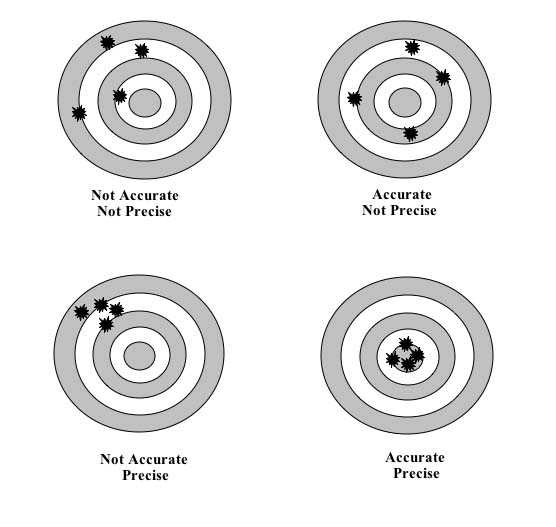
The second definition, relevant to 2x2 contingency tables, means technically 'TP/(TP+FP)' or the ratio of True Positives to Total Positives (the latter of which is the sum of True Positives and False Positives). What it means (for how good a test is a measure of reality) is how well the test (when positive) captures the phenomenon. A technical synonym (which means it is an exact synonym which means they are identical) is Positive Predictive Value or PPV. Almost as metaphorically meaningful, but really that doesn't matter, the meaning is stipulated to be the ratio. The generic picture of a 2x2 contingency table is (from alpine.atlassian):
But wait! you say. You see two by two tables in each case, and both are about how good a test is with reality. Isn't that the same? Yes, they involve some similar principles, but they appear in different circumstances. One is about the significant digits of real values vs the average (a computation on continuous values) where variance and average are very different computations. The other is about comparison of two different binary (yes/no) values, an identical dimension of true vs false.
In addition, note that 'accuracy' is also for two words spelled the same way (one for average being close to true, and for 2x2 tables the ratio of TP plus TN to the total, the diagonal in the image above). The contingency table 'accuracy' is not as popular a concept/term though.
The lessons to learn then is:
- these two concepts, spelled the same way, are very different, even though metphorically they have something to do with how good a set of numbers is.
- some technical words have more than one meaning. Really really different meanings. But usually context will tell you which is which. If you're talking about just the quality of a metric by itself, then 'precision' is the variance. If contingency tables, then it's the same as PPV (positive predictive value).
See also:
http://en.wikipedia.org/wiki/Accuracy_and_precision
which has a section on both.
Wednesday, May 6, 2015
"A man generally supposes that there must be some meaning in words"
"A man generally supposes that there must be some meaning in words"
Or "You keep using that word, I do not think it means what you think it means”
There are all sorts of fallacies in argumentation (or almost equivalently transfer of information). Faulty logic, all the fun fallacies of irrelevance like appeals to authority and numbers and such.
One that particularly bothers me is word usage. Words have many meanings, technical and informal. Even in the most technical of languages, science and mathematics, where words are supposed to have clear precise meanings, they still use metaphor and connotation. A 'normal' curve, a 'regular' graph, a 'set'. An autism-spectrum difficulty (I use that metaphorically) is not knowing when to care if a word is intended formally or not; everything is literal when talking tech.
That's all empty rationalization in order to introduce this, a proverb by Schopenhauer:
"A man generally supposes that there must be some meaning in words:
This quote is verbatim from a translation. That is the German is in the translation and the original identically, and The original doesn't have the '[Commonly...] part. So really 'A man..' is the only part truly translated.
The confusing thing here (among many) is what is the source of 'Gewöhnlich...'. Is that a quote by Schopenhauer of someone else, German or otherwise? Or did S set it aside as special? S gave no reference, but he doesn't set aside any other passage in a similar manner. Ah... all it takes is looking it up. It is by Goethe. No matter where you go, someone has been there before. That virgin forest, with rotting fallen trunks and random unruly thickets? Reclaimed farmland. More than once.
Also, looking at the original German, the single line before the quote is
which is literally "the opponent through senseless word-torrent is baffled and amazed" or more idiomatically "You can baffle and amaze your opponent by a flood of words" (modulo lots of synonyms for every word but all giving about the same idea)
This is, though it may share in the sentiment of the translation, not the same thing. At least not even a loose translation. It's as though the translator digested the words, slept on it, went on a trip a few days, and then gave kind of an implication of an idea of the import of the sentence. But not a translation.
Some translation also include right before:
which is a close translation. It's as though the translators think they should just paraphrase the Goethe quote and drop S's.
Anyway, what's the point? It really bugs me when people use words wrong.
Update: Duh. It's from Faust (EN: scene VI The Witch's Kitchen) or (DE: Hexenkueche)
References
The translation:
The Art of Controversy (The Art of Being Right) Strategem 36 (p 37-39), note the long passage in German from The Vicar of Wakefield
The original in German:
Die Kunst, Recht zu behalten Kunstgriff 36 (p 37-39), note the long passage in German from The Vicar of Wakefield
The original English of the passage displaying the BS:
The Vicar of Wakefield chapter 7 in the original English
The passage, for convenience:
The Squire: I hope you'll not deny that whatever is is. If you don't grant me that, I can go no further.
Moses: Why, I think I may grant that, and make the best of it.
S: I hope too you'll grant that a part is less than the whole.
M: I grant that too, it is but just and reasonable.
S: I hope, you will not deny, that the two angles of a triangle are equal to two right ones.
M: Nothing can be plainer
S: Very well, the premises being thus settled, I proceed to observe, that the concatenation of self existences, proceeding in a reciprocal duplicate ratio, naturally produce a problematical dialogism, which in some measure proves that the essence of spirituality may be referred to the second predicable
M: Hold, hold, I deny that: Do you think I can thus tamely submit to such heterodox doctrines?
S: What, not submit! Answer me one plain question: Do you think Aristotle right when he says, that relatives are related?
M: Undoubtedly
S: If so then, answer me directly to what I propose: Whether do you judge the analytical investigation of the first part of my enthymem deficient secundum quoad, or quoad minus, and give me your reasons: give me your reasons, I say, directly.
M: I protest, I don't rightly comprehend the force of your reasoning; but if it be reduced to one simple proposition, I fancy it may then have an answer.
S: O sir, I am your most humble servant, I find you want me to furnish you with argument and intellects too
Notes:
"Whatever is, is"
Aristotle's Law of Identity - so incontrovertible that it is hard to imagine even the need to state it. Of course, libraries have been filled with it's discussion.
"The part is less than the whole"
Common Notion 5 from Euclid's Elements incontrovertible but still needs thought to digest why it even needs to be said.
"The two angles of a triangle are equal to two right angles" (should be 'three angles of a triangle')
One of the early theorems in Euclid's Elements - not obvious at all to modern readers, and needs an explanation. In past centuries where al the mathematical teaching provided was sums and Euclid all day long, it would have been pounded in day after day and therefore purely by the propaganda of teaching, would have been incontrovertible.
This is then followed by a load of horseshit. Twice. The strategy is obscurantism of the mean kind (the good kind? 'lying to children'. wait, that doesn't sound nice at all), to use words that sound good, but are so abstruse, that one just assumes they must be right (because it would be rude or time-consuming to question them) but used either to hide ignorance (and win the argument anyway) or hide illumination from the others.
Or "You keep using that word, I do not think it means what you think it means”
There are all sorts of fallacies in argumentation (or almost equivalently transfer of information). Faulty logic, all the fun fallacies of irrelevance like appeals to authority and numbers and such.
One that particularly bothers me is word usage. Words have many meanings, technical and informal. Even in the most technical of languages, science and mathematics, where words are supposed to have clear precise meanings, they still use metaphor and connotation. A 'normal' curve, a 'regular' graph, a 'set'. An autism-spectrum difficulty (I use that metaphorically) is not knowing when to care if a word is intended formally or not; everything is literal when talking tech.
That's all empty rationalization in order to introduce this, a proverb by Schopenhauer:
"A man generally supposes that there must be some meaning in words:
Gewöhnlich glaubt der Mensch, wenn er nur Worte hört, Es müsse sich dabei doch auch was denken lassen[Commonly man believes that if he only hears some words, there must be something in them to ponder over]"
This quote is verbatim from a translation. That is the German is in the translation and the original identically, and The original doesn't have the '[Commonly...] part. So really 'A man..' is the only part truly translated.
The confusing thing here (among many) is what is the source of 'Gewöhnlich...'. Is that a quote by Schopenhauer of someone else, German or otherwise? Or did S set it aside as special? S gave no reference, but he doesn't set aside any other passage in a similar manner. Ah... all it takes is looking it up. It is by Goethe. No matter where you go, someone has been there before. That virgin forest, with rotting fallen trunks and random unruly thickets? Reclaimed farmland. More than once.
Also, looking at the original German, the single line before the quote is
Den Gegner durch sinnlosen Wortschwall verdutzen, verblüffen
which is literally "the opponent through senseless word-torrent is baffled and amazed" or more idiomatically "You can baffle and amaze your opponent by a flood of words" (modulo lots of synonyms for every word but all giving about the same idea)
This is, though it may share in the sentiment of the translation, not the same thing. At least not even a loose translation. It's as though the translator digested the words, slept on it, went on a trip a few days, and then gave kind of an implication of an idea of the import of the sentence. But not a translation.
Some translation also include right before:
You may also puzzle and bewilder your opponent by mere bombast
which is a close translation. It's as though the translators think they should just paraphrase the Goethe quote and drop S's.
Anyway, what's the point? It really bugs me when people use words wrong.
Update: Duh. It's from Faust (EN: scene VI The Witch's Kitchen) or (DE: Hexenkueche)
References
The translation:
The Art of Controversy (The Art of Being Right) Strategem 36 (p 37-39), note the long passage in German from The Vicar of Wakefield
Die Kunst, Recht zu behalten Kunstgriff 36 (p 37-39), note the long passage in German from The Vicar of Wakefield
The original English of the passage displaying the BS:
The Vicar of Wakefield chapter 7 in the original English
The passage, for convenience:
The Squire: I hope you'll not deny that whatever is is. If you don't grant me that, I can go no further.
Moses: Why, I think I may grant that, and make the best of it.
S: I hope too you'll grant that a part is less than the whole.
M: I grant that too, it is but just and reasonable.
S: I hope, you will not deny, that the two angles of a triangle are equal to two right ones.
M: Nothing can be plainer
S: Very well, the premises being thus settled, I proceed to observe, that the concatenation of self existences, proceeding in a reciprocal duplicate ratio, naturally produce a problematical dialogism, which in some measure proves that the essence of spirituality may be referred to the second predicable
M: Hold, hold, I deny that: Do you think I can thus tamely submit to such heterodox doctrines?
S: What, not submit! Answer me one plain question: Do you think Aristotle right when he says, that relatives are related?
M: Undoubtedly
S: If so then, answer me directly to what I propose: Whether do you judge the analytical investigation of the first part of my enthymem deficient secundum quoad, or quoad minus, and give me your reasons: give me your reasons, I say, directly.
M: I protest, I don't rightly comprehend the force of your reasoning; but if it be reduced to one simple proposition, I fancy it may then have an answer.
S: O sir, I am your most humble servant, I find you want me to furnish you with argument and intellects too
Notes:
"Whatever is, is"
Aristotle's Law of Identity - so incontrovertible that it is hard to imagine even the need to state it. Of course, libraries have been filled with it's discussion.
"The part is less than the whole"
Common Notion 5 from Euclid's Elements incontrovertible but still needs thought to digest why it even needs to be said.
"The two angles of a triangle are equal to two right angles" (should be 'three angles of a triangle')
One of the early theorems in Euclid's Elements - not obvious at all to modern readers, and needs an explanation. In past centuries where al the mathematical teaching provided was sums and Euclid all day long, it would have been pounded in day after day and therefore purely by the propaganda of teaching, would have been incontrovertible.
This is then followed by a load of horseshit. Twice. The strategy is obscurantism of the mean kind (the good kind? 'lying to children'. wait, that doesn't sound nice at all), to use words that sound good, but are so abstruse, that one just assumes they must be right (because it would be rude or time-consuming to question them) but used either to hide ignorance (and win the argument anyway) or hide illumination from the others.
Subscribe to:
Posts (Atom)