Sunday, June 21, 2015

"You don't see people casually become neurosurgeons in their spare time"

From James Hague, Organizational Skills Beat Algorithmic Wizardry via John Cook, The most important skill in software

This is the reason there are so many accidental programmers. You don't see people casually become neurosurgeons in their spare time--the necessary training is specific and intense--but lots of people pick up enough coding skills to build things on their own.

Yeah, why is it that so many professional programmers are self-taught? So a brain surgeon is the top of the charts, but even a family practice doctor, the front line of medicine, still has the education and training of a rocket scientist.

So that's a bit tantalizing 'This is the reason...'. But Hague doesn't really give a reason. OK he sorta does. Previously he says:

To a great extent the act of coding is one of organization [not algorithmic wizardry]. Refactoring. Simplifying. Figuring out how to remove extraneous manipulations here and there.
Except programmers don't get hired because they show how well they can reorganize things, but by how they write an algorithm (classic interview questions). Sure, I bet there are some refactoring questions in some places (and I think those are just as useful a measure as the algorithm questions). But what gets you hired is your knowledge of the syntax of a programming language and maybe its libraries. But that's interviews and hiring.

It seems that Hague is saying that 'refactoring well' is the key to successful programming, not algorithmic wizardry. Historically, programming was algorithmic wizardry (a la CLRS) because that's what computers were good for, calculating extremely difficult mathematical or combinatorial computations. What is the shortest path that visits all nodes in this special graph? (greedy just doesn't work) How do you solve for a vector in a matrix equation using Gaussian elimination without using extra space? (space was at a premium). Those tasks needed wizardry, the kind of thought that goes into solving a Rubik's Cube, having good memory for a few examples, seeing patterns in them, seeing in the patterns, always an eye for optimization.
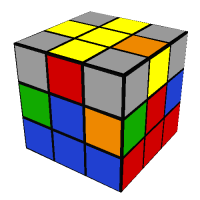

How do you get that one yellow orange edge piece in place without messing everything else up? Figuring that out takes a lot of 3D imagination ability, a lot of memory, and a lot of trial and error, but eventually you come up with a set pattern to follow like "U' L' U L U F U' F'" (ha ha that's technical, and not doable without, but that's what algorithms are). But once you have the pattern, it's straightforward to compose with other patterns (which you have to figure out possibly totally different from the patterns for the above or maybe somewhat similar)

But nowadays it seems lots of those difficult algorithms have been solved. They're in a library. You don't have to reimplement red-black trees to create a database index, you use the library. Programming today is more like 'Rush Hour', where you're moving a small set of pieces, some blocking others, but maybe the first are blocking the latter and you have to plan ahead.


You're rearranging a bunch of pieces to make the whole thing come out. For a webapp, you need some forms on the front end, communicating via http calls to a backend with a database, but your webapp needs to run on a smart phone and a tablet, too. All straightforward large pieces, but to make sure that you make it easier for yourself to modify later, you want to separate the pieces well.

What makes a good programmer, and allows so many without academic education in it to perform well, is that this kind of large piece thinking is usually amenable to anybody with a technical background, engineering, math, science. Most of such fields promote detail-oriented, symbolic thinking and memory (all of which is good to grasp the computational nature of programming) but also the

So the answer to the original question? Not everybody is an algorithms wizard, can figure out Rubik's cube, there's lots of special talent needed for that. But most technically oriented people, without specific experience, can program nowadays, can solve Rush Hour problems. It's not easy (especially for the more difficult layouts), but most technically oriented people can plow through it. You don't need to know linear algebra to do a website, you just need to read a few docs in order to move a handful of pieces around.

Thursday, June 18, 2015

The term 'Big Data' now means 'More Data Than You Thought Of Before'

What is 'Big Data'? For the past few years (let's say roughly 5, before which it was not nearly as popular as after) everybody knows what it means. It's a bunch of data and there's a lot of it. Also machine learning and FitBit. The term has come to mean many things. It was originally coined.. well.. it's sorta vague. And its current usage (how it is used by people) is not the same as its intended definition.

First, what is it supposed to be now? Wikipedia gives the following:

Big data is a broad term for data sets so large or complex that traditional data processing applications are inadequate

Conveniently a source search for the provenance of the term has been done: who first used it in a similar way to what it means now.

And Forbes gave a list of many possible definitions, some more substantive than others. These are all definitions I can agree with. There's data, it's structured in weird new ways, and it comes from new sources that produce gobs and gobs of it. The term 'Big Data' is used to contrast with traditional data, its storage and techniques. Traditional data is not 'Big' and therefore is 'small' and its techniques are 'old'. I'd say any kind of relational database (SQL related) is traditional.

Big data is things like mouse clicks or even mouse movements on a screen, or fitbit near continuous polling of heart rate and blood O2 (does it really do that? I don't know!). Or road sensors checking car presence on a road or at a stop light. Every possible transaction, position.

The thing is that what a lot of people are calling 'Big Data' are really pretty traditional. For example, what about credit card transactions, is that big? They're constantly checking them for out of the ordinary purchases so that they can cut off my service right when I need it at an airport. Or tax returns? There must be millions, and for even the simplest return, hundreds of entries and calculations! Or weather sensors for near continuous temp/pressure/precip/windspeed?  These are old data sources, no one would call them Big Data, they have been around long enough that they -are- traditional. Yet they are all at the forefront of large and complex systems design.

And then there are the false positives, those things that are called big data but don't really fit that definition. For example, electronic health records collect a lot of information on a patient. But... it's about as traditional as traditional gets. Straightforward collection of forms or transcripts or lists of entries.

I am purposefully leaving out things like EKGs or radiological images, not because they deny my point but because they are the exception that proves the rule. They both take of gobs and gobs of space (for radiology a single CT scan of the body can take up X Gig. In the best sense, the data 'size' of a study is 1, or rather it is the size of the radiologist's text report describing the results found in the images ('Insignificant thyroidal calcification. No other findings') that counts, and that hardly counts. The scale is pretty small.

So what is not Big Data that actually isn't Big Data (by the official definition)? There's the database of clients that one company manages, all the contact information, the account transactions. Classic relational database. There's the auto parts store with its database of suppliers and buyers, all the various parts for sale with their characteristics and which make/model/year they work with, the list of sales and inventory. Classic relational database.

Also, the term 'Big Data' has a particularly ... millenial 'kids-these-days' feel to it. It is a bit inarticulate in that it's not saying exactly what it is, but everyone has a good idea of what they think it should mean. 'Big' is about as meaningful as 'wow'.

Anyway, 'Big Data' ... I'll use it for what everybody else uses it for (I don't know what that is yet !), both big new things, and also smaller traditional things that most people never really thought about before.

Footnote: this is entirely patterned after the term 'superccomputer' which has a similar history. In the late 70's Cray I was a supercomputer, and today (mid 2010's) a smart phone is just a little ... thing, despite the fact that the smart phone computes more flops than the Cray. A supercomputer is pretty much just the best possible computer in existence -right now-.

Tuesday, June 16, 2015

SWOT Analysis of SWOT Analysis

Where is this company going? Who are our competitors? How do we increase market penetration?

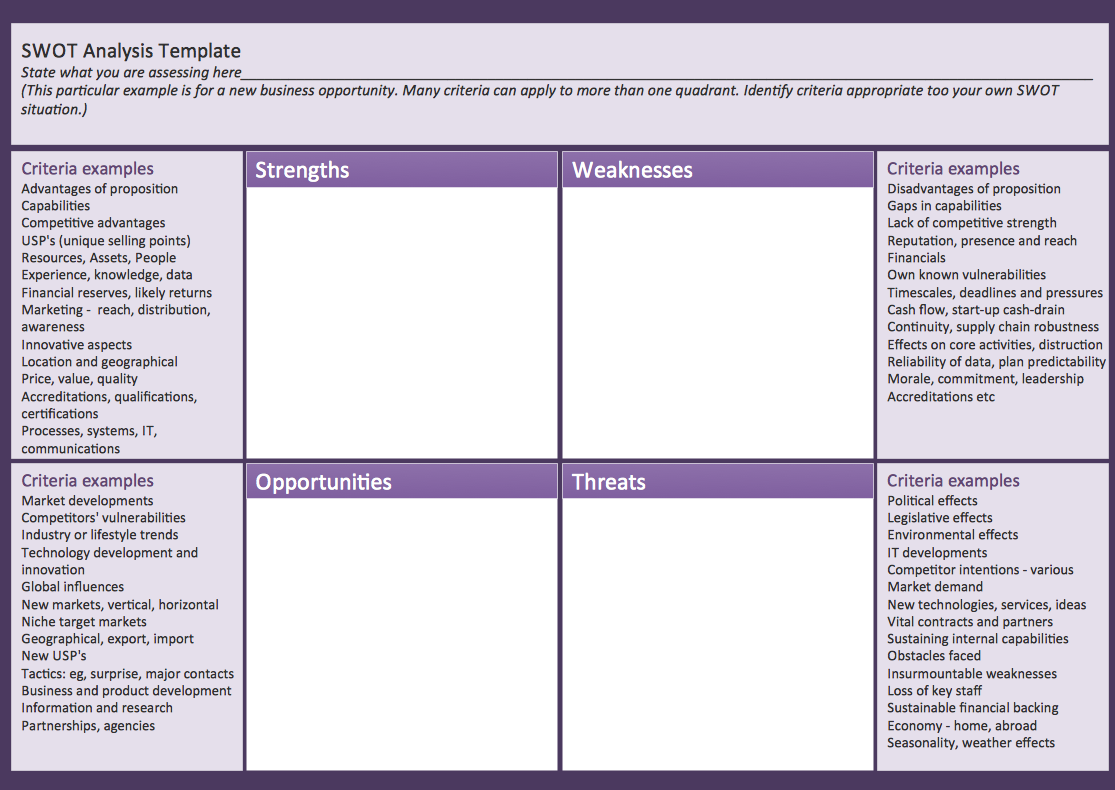
SWOT analysis, a diagram listing Strengths, Weaknesses, Opportunities, and Threats, is a great high level management strategy tool in business. It doesn't tell you what to do when there's a problem, it just helps you describe a situation.

It forces you to make explicit both good and bad, and the internal and external features of your situation. As a graphic model, it puts like things in the same place and gives a well-defined, limited structured place to put them. You can use it for the highest level (for an entire company) or for a very low level (one particular product), or even for the most technical of things (should I learn a particular technical skill?). It's not for everything and it doesn't do everything for the things it is for.

Here's a template of a SWOT analysis chart with the kinds of questions that go in each:


(from http://www.conceptdraw.com/How-To-Guide/swot-analysis-matrix-template)

There are two axes, either internal or external, and the quality either good or bad. It's probably bad form to mention the negative of an item from the positive side, sort of non-creative and redundant. Threats can be competitors, but it may also be useful to do an entire SWOT on a competitor for true comparison sake.

There are many examples and explanations of SWOT analysis. Here's a simple example for a bank:


(from http://www.theasianbanker.com/benchmarking/our-tools)

Unfortunately, I couldn't find any examples of real  SWOTs (from the real world), so a made up academic example will have to do.

So now the point of this is to judge SWOT by some judgement method. Since SWOT analysis is exactly one of those methods, let's turn it on itself. I (and other sites) have given a wordy analysis, so I'll just give the SWOT analysis as is without any additional commentary.

Internalities

Strengths
- well-defined, simple structure, limits issues to judge
- simple to understand
- quick to complete, low cost
- makes explicit for all ideas of things to do (externalities) and how well you can expect to do them (internals)
- doesn't need too much knowledge of the company to create details

Weaknesses
- no ranking of importance of items
- too superficial, oversimplification of issues, shallow
- many details left out, lots of context left out
- not operational, doesn't help with figuring out what to do
- only binary, hard to include important but multifaceted issues
- balance implied but not necessary


Externalities

Opportunities
- many people don't know of this method
- lo-tech, doesn't need (computer) tools to fill out
- can be used for non-business situations

Threats
- there are many other forms of business analysis (Gannt charts, weighted average, competency chart)
- easily overlooked because so shallow
- results often overlooked, swamped by other methods

So there's not much that can be said reasonably about opportunities or threats here. SWOT is an analysis method, not a startup. So I guess that's another weakness of SWOT, that  it's not applicable in more contexts. Externalities are mostly relevant in gaming situations where there are true competitors vying for resources (like in a business situation). Opportunities and threats seem geared almost directly to a sales or niche competition (greenfield vs brownfield, red ocean vs blue), how to use one's strengths to pursue an opportunity.

One thing missing from this analysis of analysis, which doesn't fit in the restrictions of this analysis, is the range of competitors. It's a detail mentioned but not made explicit. I feel like it would be a great lack if those details aren't mentioned here even though it doesn't fit within the constraints of the academic problem.

The competitors, or rather alternatives to SWOT analysis are:
- TOWS - builds on top of SWOT, pairs of SWOT quadrants
- SOAR - the positive version of SWOT, Strengths, Opportunities, Aspirations and Results
Growth Share Matrix - scatter plot of businesses by market share vs growth rate
- Gap Analysis - comparison of actual with potential performance

Surely there are other more substantive alternatives to SWOT?


Tuesday, June 9, 2015

Why are there no moon base plans?

The  current space obsession is a manned mission to Mars. In the past couple of years there's been all sorts of stories and books on how to to do it, what the purpose of such a mission is, the difficulties, the variations.

Every president since Bush Sr (wait did Obama mention it?) has promised to put a man on mars (wait, did -Clinton do it?).

It seems like these big media plans are almost as common as plans to create a high speed rail line between NYC and Washington (or San Francisco and LA, or Chicago and St. Louis). Every new governor

I'm all gung ho for every sci-fi inspired space plan: mining asteroids for precious resources, terraforming Ganymede for farming, solar sails to travel among the planets.

But.. this should be sci-fi inspired engineering, not science fantasy. Wouldn't it be more cost effective and profitable and room for learning more about engineering around off-earth environments if we went incrementally? There is a space station, a bit smallish, with worldwide support. Shouldn't there be some intermediary step, like a moon base?

First, an efficient transport mechanism to a low orbit space station, via rockets or space elevator or what have you.

Then maybe an intermediate high orbit one.

Then a minimal lunar base.

Then lunar L1 and L2 satellite stations.

Then an expanded lunar base.

...and a whole bunch of intermediary supply chain steps, not just to support a permanent connection (realistically, we don't know if we'l be able to support that in the long term), but to support exploitation of those intermediate steps as ends to themselves.

Then, once all that's done, a visit to Mars (because all those previous items will make the trip that much easier. Don't blow a shitload of money on a one-off to Mars. Make it realistically attainable.

Also, in parallel (and maybe with more money than carved out for a manned mission), that much more robotic exploration. Let the machines die first. It's less expensive and less upsetting and demoralizing.

Oh. I'm sorry. There -are- plans for a moon base.. But I have no idea if this is part of a grand plan.

Also, what's the business plan other than 'Holy shit this will be cool'? (I'm all for that business plan, but my funding is in science fiction dollars)

Ioannidis' "Why Most Published Research Findings Are False" - two kinds of 'false'

Ioannidis put out "Why Most Published Research Findings Are False" 10 years ago.

The title is provocative. False? Really? Oh my god, are bridges falling? (no). But are people having adverse reactions to this medication that doesn't really do anything? Very probably!

But really, what did Ioannidis mean by 'false'? Most people think of 'false' as the entire opposite of 'true' (well, there's very little denying that!) But what I mean is rather 'false' means that the entire opposite of a statement is true. And that subtlety makes a difference.

"This apple is red"... that is either true or false. It may be entirely green, in which case that statement is perfectly false. Or it may be mostly red with green spots. Or it may be partly green and partly red about the same area. Or maybe it is about to turn from green to red and is paradoxically half way between. You can judge for yourself how true or false each of those might be. But there is undoubtedly play or vagueness in those words, in 'red' and 'false, maybe even 'is'.

When it comes to experiments, the situation is now about a number of things. 'All apples are red'. That is certainly not the case, because some are green. If there is at least one apple that is not red, then that statement is false (not only be everyday common sense, but by the stipulated mathematical/logical usage of quantifiers like 'all'. But scientifically 'all apples are red' can be statistically justified (and it is accepted usage) if there are a reasonable few that aren't red. That is, 'All apples are red, except for a few which don't really count'.

But that is my semantic analysis. It is totally relevant to modern research, and gives a reasonable interpretation to the title of the paper. Most experimental research is trying to say something like "All X are Y, for the most part". Ioannidis in his paper is actually pursuing another definition of false. Sorry, not another definition, but a perfectly good, oops the best, most correct definition of false... in a particular context. Well, in the interests of full disclosure, he uses it two ways, in the traditional definit... oops context, and then also in a computational context.

How he uses 'false' this is not terribly complex and is very logical and supportable and I agree with it and it is a useful way of using 'false'... but it's not what you expect. He takes the usual 2x2 statistical hypothesis testing paradigm with its type I and type II errors ("Apples are mostly red" vs "Apples are not mostly red (a non-negligeable amount are not red" as competing hypotheses and then testing against reality).

What Ioannidis does is take the parameters for hypothesis testing, alpha the probability of a false negative, beta the probability of a false positive (this is also the parameter for determining power, or the number of instances required to guarantee a significant result if there is one), and R the prior probability of the hypothesis being true, and computes the PPV (positive predictive value), using very elementary and straightforward arithmetic (see Table 1)


The PPV is TP/(TP+FP) = (1-beta)R/(R+alpha-beta*R). OK that's not 2+2, but it's not at all rocket science. He simplifies this considerably by setting alpha to be the usual cutoff for significance acceptability:

Since usually the vast majority of investigators depend on a = 0.05, this means that a research finding is more likely true than false if (1 - β)R > 0.05.
He then goes to show in a later table 4, that for given beta and R (and bias u) that, given a few types of studies, studies in each type having roughly the same params, each kind of study will have a probability of being ... true (statistically/roughly/acceptably).


Presumably, He considers only those top two to be generally true, and all the rest presumably false (the latter even in the loosey goosey/benefit of the doubt/non-categorical/for the most part 'true').

The press for this article often claims that Ioannidis says that '75% of studies are false'. Again, presumably, that figure comes from a some weighted average, over all studies (in some unspecified context) using the above table. I have not done that computation, nor the setup work of judging a large set of studies (medical?) and which category they lie in.


Friday, June 5, 2015

Precision != Precision, or Measurement, Categorical Variables, and Polysemy

Two words in data science are unfortunately pronounced and spelled exactly the same. They are 'precision' and 'precision'.

Both are very technical in meaning Their informal meaning, though not wrong exactly and metaphorically in the ball park, does not give much clue as to the exact meanings.

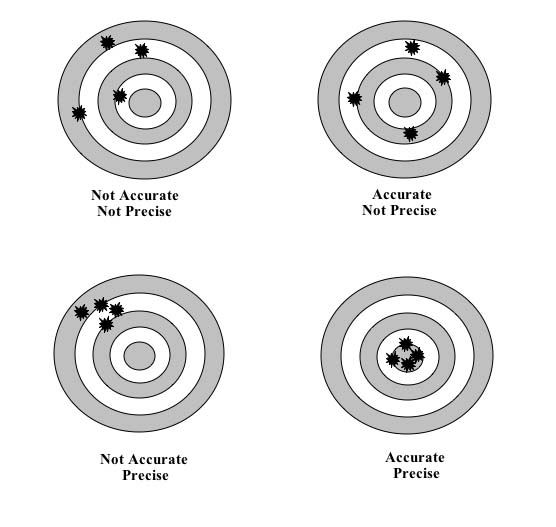
The first one meaning is relevant to measurement. It means 'how many digits in a numerical measure are used' or very similarly the variance of a set of measures. This is in contrast to 'accuracy' which means 'on average how correct'. A number is 'precise' if it has lots of digits to the right of the most significant digit (or the set has very small variance). A set of numbers is 'accurate' if the set's average is very close to the true value (note the grammar: precision can apply to a single number but accuracy is for a set). Here is a classic picture of the difference of 'precision' with 'accuracy' (from wikipedia):


Another view is high and low precision and accuracy (from NOAA)


The second definition, relevant to 2x2 contingency tables, means technically 'TP/(TP+FP)' or the ratio of True Positives to Total Positives (the latter of which is the sum of True Positives and False Positives). What it means (for how good a test is a measure of reality) is how well the test (when positive) captures the phenomenon. A technical synonym (which means it is an exact synonym which means they are identical) is Positive Predictive Value or PPV. Almost as metaphorically meaningful, but really that doesn't matter, the meaning is stipulated to be the ratio. The generic picture of a 2x2 contingency table is (from alpine.atlassian):


But wait! you say. You see two by two tables in each case, and both are about how good a test is with reality. Isn't that the same? Yes, they involve some similar principles, but they appear in different circumstances. One is about the significant digits of real values vs the average (a computation on continuous values) where variance and average are very different computations. The other is about comparison of two different binary (yes/no) values, an identical dimension of true vs false.


In addition, note that 'accuracy' is also for two words spelled the same way (one for average being close to true, and for 2x2 tables the ratio of TP plus TN to the total, the diagonal in the image above). The contingency table 'accuracy' is not as popular a concept/term though.

The lessons to learn then is:

- these two concepts, spelled the same way, are very different, even though metphorically they have something to do with how good a set of numbers is.

- some technical words have more than one meaning. Really really different meanings. But usually context will tell you which is which. If you're talking about just the quality of a metric by itself, then 'precision' is the variance. If contingency tables, then it's the same as PPV (positive predictive value).

See also:
http://en.wikipedia.org/wiki/Accuracy_and_precision
which has a section on both.

Wednesday, May 6, 2015

"A man generally supposes that there must be some meaning in words"

"A man generally supposes that there must be some meaning in words"

Or "You keep using that word, I do not think it means what you think it means” 

There are all sorts of fallacies in argumentation (or almost equivalently transfer of information). Faulty logic, all the fun fallacies of irrelevance like appeals to authority and numbers and such.

One that particularly bothers me is word usage. Words have many meanings, technical and informal. Even in the most technical of languages, science and mathematics, where words are supposed to have clear precise meanings, they still use metaphor and connotation. A 'normal' curve, a 'regular' graph, a 'set'. An autism-spectrum difficulty (I use that metaphorically) is not knowing when to care if a word is intended formally or not; everything is literal when talking tech.

That's all empty rationalization in order to introduce this, a proverb by Schopenhauer:

"A man generally supposes that there must be some meaning in words:
Gewöhnlich glaubt der Mensch, wenn er nur Worte hört, Es müsse sich dabei doch auch was denken lassen
[Commonly man believes that if he only hears some words, there must be something in them to ponder over]"

This quote is verbatim from a translation. That is the German is in the translation and the original identically, and The original doesn't have the '[Commonly...] part. So really 'A man..' is the only part truly translated.

The confusing thing here (among many) is what is the source of 'Gewöhnlich...'. Is that a quote by Schopenhauer of someone else, German or otherwise? Or did S set it aside as special? S gave no reference, but he doesn't set aside any other passage in a similar manner. Ah... all it takes is looking it up. It is by Goethe. No matter where you go, someone has been there before. That virgin forest, with rotting fallen trunks and random unruly thickets? Reclaimed farmland. More than once.

Also, looking at the original German, the single line before the quote is

Den Gegner durch sinnlosen Wortschwall verdutzen, verblüffen

which is literally "the opponent through senseless word-torrent is baffled and amazed" or more idiomatically "You can baffle and amaze your opponent by a flood of words" (modulo lots of synonyms for every word but all giving about the same idea)

This is, though it may share in the sentiment of the translation, not the same thing. At least not even a loose translation. It's as though the translator digested the words, slept on it, went on a trip a few days, and then gave kind of an implication of an idea of the import of the sentence. But not a translation.

Some translation also include right before:

You may also puzzle and bewilder your opponent by mere bombast

which is a close translation. It's as though the translators think they should just paraphrase the Goethe quote and drop S's.

Anyway, what's the point? It really bugs me when people use words wrong.

Update: Duh. It's from Faust (EN: scene VI The Witch's Kitchen)  or (DE: Hexenkueche)

References

The translation:
The Art of Controversy (The Art of Being Right) Strategem 36 (p 37-39), note the long passage in German from The Vicar of Wakefield

The original in German:
Die Kunst, Recht zu behalten Kunstgriff 36 (p 37-39), note the long passage in German from The Vicar of Wakefield

The original English of the passage displaying the BS:
The Vicar of Wakefield chapter 7  in the original English

The passage, for convenience:

The Squire: I hope you'll not deny that whatever is is. If you don't grant me that, I can go no further.
Moses: Why, I think I may grant that, and make the best of it.
S: I hope too you'll grant that a part is less than the whole.
M: I grant that too, it is but just and reasonable.
S: I hope, you will not deny, that the two angles of a triangle are equal to two right ones.
M: Nothing can be plainer
S: Very well, the premises being thus settled, I proceed to observe, that the concatenation of self existences, proceeding in a reciprocal duplicate ratio, naturally produce a problematical dialogism, which in some measure proves that the essence of spirituality may be referred to the second predicable
M: Hold, hold, I deny that: Do you think I can thus tamely submit to such heterodox doctrines?
S: What, not submit! Answer me one plain question: Do you think Aristotle right when he says, that relatives are related?
M: Undoubtedly
S: If so then, answer me directly to what I propose: Whether do you judge the analytical investigation of the first part of my enthymem deficient secundum quoad, or quoad minus, and give me your reasons: give me your reasons, I say, directly.
M: I protest, I don't rightly comprehend the force of your reasoning; but if it be reduced to one simple proposition, I fancy it may then have an answer.
S: O sir, I am your most humble servant, I find you want me to furnish you with argument and intellects too

Notes:
"Whatever is, is"
Aristotle's Law of Identity - so incontrovertible that it is hard to imagine even the need to state it. Of course, libraries have been filled with it's discussion.

"The part is less than the whole"
Common Notion 5 from Euclid's Elements incontrovertible but still needs thought to digest why it even needs to be said. 

"The two angles of a triangle are equal to two right angles" (should be 'three angles of a triangle')
One of the early theorems in Euclid's Elements - not obvious at all to modern readers, and needs an explanation. In past centuries where al the mathematical teaching provided was sums and Euclid all day long, it would have been pounded in day after day and therefore purely by the propaganda of teaching, would have been incontrovertible.

This is then followed by a load of horseshit. Twice. The strategy is obscurantism of the mean kind (the good kind? 'lying to children'. wait, that doesn't sound nice at all), to use words that sound good, but are so abstruse, that one just assumes they must be right (because it would be rude or time-consuming to question them) but used either to hide ignorance (and win the argument anyway) or hide illumination from the others.

Wednesday, January 4, 2012

Comments on Tractatus: 3 The logical picture of the facts is the thought

3 The logical picture of the facts is the thought.
Introduction of the 'think' concept. So now what does 'think', thought' etc mean. Is it the mini-activity of the mind/brain?
3.001 “An atomic fact is thinkable”—means: we can imagine it.
presumably a picture is imaginable too. Who knows...picture, fact, thought,

3.01 The totality of true thoughts is a picture of the world.
Are there other pictures? other pictures of the world?

3.02 The thought contains the possibility of the state of affairs which it thinks.What is thinkable is also possible.
First sentence: empty philosophical blather.Second, untrue.

3.03 We cannot think anything unlogical, for otherwise we should have to think unlogically.
This is patently untrue. Whether by deliberate Lewis Carrollisms, or the veryday drudgery of making mistakes or working with limited knowledge (bounded rationality), or the mixed up conflatino of ideas that is so easy to do, there's all sort s of illogical things we think. viz Whitman (Leaves of Grass 14)
Do I contradict myself? 
Very well, then, I contradict myself; 
(I am large—I contain multitudes.)

3.031 It used to be said that God could create everything, except what was contrary to the laws of logic. The truth is, we could not say of an “unlogical” world how it would look.
A non sequitur.

3.032 To present in language anything which “contradicts logic” is as impossible as in geometry to present by its co-ordinates a figure which contradicts the laws of space; or to give the co-ordinates of a point which does not exist.
Another non sequitur. One can say all sorts of illogical things. And then (what does not follow) one can describe all sorts of points which have no possibility of existing physically; the laws of physics son't limit what you can say. W seems to have, despite all his interest in philosophizing about mathematics, little understand of how mathematics works.

3.0321 We could present spatially an atomic fact which contradicted the laws of physics, but not one which contradicted the laws of geometry.
Here finally is some real philosophical content: the difference between ... physics and math: experience and thought? no one can think of contradictory things. induction and deduction? This is the closest so far.

3.04 An a priori true thought would be one whose possibility guaranteed its truth.
W is now playing with modal logic. A 'fact' whose possibility implies its truth? That seems a type mismatch. The logic will (or won't) have that as a rule of inference not the fact itself.

3.05 We could only know a priori that a thought is true if its truth was to be recognized from the thought itself (without an object of comparison).
A truth justifies itself? That seems crazy.

3.1 In the proposition the thought is expressed perceptibly through the senses.
What follows is an attempt to explain what propositions and facts and signs and names are. I think inarticulately and unsuccessfully. He is trying to be explicit and articulate about the operation of propositional logic. An elementary text does not go into similar excruciatingly meaningless detail. W should spend time explaining 'variable' (but I'm glad he didn't)

...
3.262 What does not get expressed in the sign is shown by its application.What the signs conceal, their application declares.
Finally something metaphorical that holds water: if the form of a proposition doesn't help ecxplain its meaning, the use or manipulation of it does.

More emptiness follows though...
3.313 An expression is thus presented by a variable, whose values are the propositions which contain the expression. (In the limiting case the variables become constants, the expressiona proposition.) I call such a variable a “propositional variable”.
Ah...now a description of 'variable', which sadly is incoherent (at least with a mathematical understanding of 'variable').

...
3.318 I conceive the proposition—like Frege and Russell—as a function of the expressions contained in it.
Hm..an actual reference for priority. It sounds like a reference to the idea of 'boolean function'.

...
3.321 Two different symbols can therefore have the sign (the written sign or the sound sign) in common—they then signify in different ways.3.322 It can never indicate the common characteristic of two objects  that we symbolize them with the same signs but by different methods of symbolizing. For the sign is arbitrary. We could
therefore equally well choose two different signs and where then would be what was common in the symbolization.
3.323 In the language of everyday life it very often happens that the same word signifies in two different ways—and therefore belongs to two different symbols—or that two words, which signify in different ways, are apparently applied in the same way in the proposition. Thus the word “is” appears as the copula, as the sign of equality, and as the expression of existence; “to exist” as an intransitive verb like “to go”; “identical” as an adjective; we speak
of something but also of the fact of something happening. (In the proposition “Green is green”—where the first word is a proper name and the last an adjective—these words have not
merely different meanings but they are different symbols.)
3.324 Thus there easily arise the most fundamental confusions (of which the whole of philosophy is full).
So W is saying that confusion sometimes comes from polysemy/amphiboly. Genius. Is sarcasm a propositional variable?

 ...
3.325 In order to avoid these errors, we must employ a symbolism which excludes them, by not applying the same sign in different symbols and by not applying signs in the same way which signify in different ways. A symbolism, that is to say, which obeys the rules of logical grammar—of logical syntax. (The logical symbolism of Frege and Russell is such a language, which, however, does still not exclude all errors.)
So symbolism should attempt to be unambiguous. Is W trying to describe math?
 ...
3.33 In logical syntax the meaning of a sign ought never to play a rôle; it must admit of being established without mention being thereby made of the meaning of a sign; it ought to presupposeonly the description of the expressions.
A tenet of formal mathematical thinking.
3.331 From this observation we get a further view—into Russell’s Theory of Types. Russell’s error is shown by the fact that in drawing up his symbolic rules he has to speak of the meaning of the signs.
3.332 No proposition can say anything about itself, because the propositional sign cannot be contained in itself (that is the “whole theory of types”).
Goedel changed all this. I can't blame W for not realizing it; hardly anybody did (except for maybe Tarski and von Neumann).
3.333 A function cannot be its own argument, because the functional sign already contains the prototype of its own argument and it cannot contain itself. If, for example, we suppose that the function F(fx) could be its own argument, then there would be a proposition “F(F(fx))”, and in this the outer function F and the inner function F must have different meanings; for the inner has
the form (fx), the outer the form  ( (fx)). Common to both functions is only the letter “F”, which by itself signifies nothing.
This is at once clear, if instead of “F(F(u))” we write “(9 ) :
F( u) : u = Fu”.
Herewith Russell’s paradox vanishes.
Again, I can't blame W for understanding future logical developments that contradict this.

...
3.343 Definitions are rules for the translation of one language into another. Every correct symbolism must be translatable into every other according to such rules. It is this which all have incommon.
This starts to sound like not nonsense.
3.344 What signifies in the symbol is what is common to all those symbols by which it can be replaced according to the rules of logical syntax.
3.3441 We can, for example, express what is common to all notations for the truth-functions as follows: It is common to them that they all, for example, can be replaced by the notations of “sp”
(“not p”) and “p _ q” (“p or q”). (Herewith is indicated the way in which a special possible notation can give us general information.)
This sounds like it should mean something logical, but I can't map it to anything in my (logical) experience.
...

Comments on Tractatus: 7 Whereof one cannot speak, thereof one must be silent.

7 Whereof one cannot speak, thereof one must be silent.
A classic aphorism. Essentially 'Faire et se taire', 'say what you mean and mean what you say, then say nothing else. This I take to be a meaningful aphorism, a truth hidden in it's tautology, that is nothing more than tautologous. I take this as the corollary of Schopenhauer's:

You may also puzzle and bewilder your opponent by mere bombast; and the trick is possible, because a man generally supposes that there must be some meaning in words

So it's not an empty tautology, but a tautology that can be explored. It has real connotations. It can be acted upon. Stop talking about things of which there is nothing to say (there -is- something to say, but nothing worthwhile is the implication).

As to language, I think this works in English as in the original German, that 'to be silent = schweigen' is the logical opposite of 'to not speak = nicht sprechen', making an aphoristic tautology as profundity worthy of Nietzsche.

A large part of the Tractatus could have been treated this way, a lot of blather that doesn't add anything, neither by its direct statement or by the fact that it is said at all. But W is both sincere and humorless. So he must have thought that what I think is empty BS is in fact really useful, but then, you really need to say that out loud: the aphorism denies itself, but a lot of the TLP text really didn't need to be said either implicitly or explicitly. So we don't disagree in principle, just in a large number of the details.

Maimonides: Seven causes of contradiction

Maimonides/Rambam in the Introduction to his "Guide for the Perplexed' gives a noticeably in-your-face immodestly humble disclaimer for the possible confusions that might follow from his text, a list of seven possible causes of contradiction that you may find in his text. (GftP is mostly a collection of short exegeses of word ambiguities and distinctions in the Talmud (among a handful of earth shaking heresies/orthodoxies (and Aristotle))).

What I am particularly impressed with in the list, even beyond the existence of the usefulness of the list, is the attempt at self-judgment. That is, here are the possible problems that you the reader may find (I, the author, have found them in other people's writings) and here is the explanation of why you may misunderstand in my own. Maybe not so humble, rather a pre-justification. Sort of a prepared feint and parry. Or a couple levels deep of Rock Paper Scissors.

Here is my interlinear commenting based on the translation by Friedlander. Maimonides describes a condition where an inconsistency may arise, and an explanation of why it is actually not an inconsistency, just a misunderstanding. I follow with the moral I take to be drawn in order to avoid the inconsistency, even though that doesn't seem to be the intention of Maimonides. It seems he is just trying to say "it's your fault for thinking there's a contradiction, and here's why". Is he talking about his own Talmudic commentaries, or those of others? I don't know.


THERE are seven causes of inconsistencies and contradictions to be met with in a literary work. The first cause arises from the fact that the author collects the opinions of various men, each differing from the other, but neglects to mention the name of the author of any particular opinion. In such a work contradictions or inconsistencies must occur, since any two statements may belong to two different authors.
The reader should distinguish among the multiple sources, that are not the author's own words. This is somewhat difficult if the author doesn't make it obvious. So my advice then should be to the author which would then be: don't plagiarize, make your references obvious, say who said what.

Second cause: The author holds at first one opinion which he subsequently rejects: in his work, however, both his original and altered views are retained.
Again this is more advice to the author. Make your pattern obvious. That is, if you plan on using a reductio ad absurdum, say so, so that it is obvious what your exposition strategy is (this one is possible 'set up something to fail. follow conclusions till a contradiction'). To the reader, don't take things out of context. Maybe the author is saying one thing to then establish its falsehood. Or maybe the author is saying that 'things are complicated', there are two sides from different perspectives and they are both true in their own context.

Third cause: The passages in question are not all to be taken literally: some only are to be understood in their literal sense, while in others figurative language is employed, which includes another meaning besides the literal one: or, in the apparently inconsistent passages, figurative language is employed which, if taken literally, would seem to be contradictories or contraries.
The author should make the metaphors explicit (or watch out for multiple meanings). The reader should not take things so literally.

Fourth cause: The premises are not identical in both statements, but for certain reasons they are not fully stated in these passages: or two propositions with different subjects which are expressed by the same term without having the difference in meaning pointed out, occur in two passages. The contradiction is therefore only apparent, but there is no contradiction in reality.
Make your assumptions explicit. Also, words have more than one meaning. To the reader, don't be so literal or assume that a word must have exactly one meaning.

The fifth cause is traceable to the use of a certain method adopted in teaching and expounding profound problems. Namely, a difficult and obscure theorem must sometimes be mentioned and assumed as known, for the illustration of some elementary and intelligible subject which must be taught beforehand the commencement being always made with the easier thing. The teacher must therefore facilitate, in any manner which he can devise, the explanation of those theorems, which have to be assumed as known, and he must content himself with giving a general though somewhat inaccurate notion on the subject. It is, for the present, explained according to the capacity of the students, that they may comprehend it as far as they are required to understand the subject. Later on, the same subject is thoroughly treated and fully developed in its right place.
This is equivalent to 'lying to children', 'Wittgenstein's ladder' or teaching by approximations, first giving the oversimplified version that is mostly inaccurate but then allowing refinements and nuance later to become more and more accurate. Hey, Einstein didn't show that Newton was wrong just that newtonian mechanics didn't work as well in large scales.

Sixth cause: The contradiction is not apparent, and only becomes evident through a series of premises. The larger the number of premises necessary to prove the contradiction between the two conclusions, the greater is the chance that it will escape detection, and that the author will not perceive his own inconsistency. Only when from each conclusion, by means of suitable premises, an inference is made, and from the enunciation thus inferred, by means of proper arguments, other conclusions are formed, and after that process has been repeated many times, then it becomes clear that the original conclusions are contradictories or contraries. Even able writers are liable to overlook such inconsistencies. If, however, the contradiction between the original statements can at once be discovered, and the author, while writing the second, does not think of the first, he evinces a greater deficiency, and his words deserve no notice whatever.
Some contradictions are actual and not apparent (all the others are about apparent contradictions that really aren't). A long sequence of inferences is problematic: is the moral to shorten it (that seems to be the cause of a true contradiction not appearing) or to fully explicate all the premises and inferences? Is he saying that we find a faulty derivation, then 'his words deserve no notice whatsoever'? That's a bit extreme. Sure it's annoying but there must be something there even if there's a contradiction.

Seventh cause: It is sometimes necessary to introduce such metaphysical matter as may partly be disclosed, but must partly be concealed: while, therefore, on one occasion the object which the author has in view may demand that the metaphysical problem be treated as solved in one way, it may be convenient on another occasion to treat it as solved in the opposite way. The author must endeavour, by concealing the fact as much as possible, to prevent the uneducated reader from perceiving the contradiction.

Things are complex. The moral here is...well sometime to make things understood you have to choose where to stop, at the simple version or after explaining a lot of complexity. Wow, M is really giving a justification for obscurantism, hide the truth from the kids, babies come from storks, gold equals money.


The special thing about these causes is that it is the first place I've ever seen any acknowledgment of other minds. Most entirely, philosophy is narcissistic and autocratic, there is only one voice, there is never even a conception of anything else, there is just voice. These causes allow that there are other minds, other ideas inspired by the text. But, aside from that great perception, these causes are all attempts to lay the blame on the reader for getting it wrong, but at least M is allowing the possibility that the reader has other ideas.

Wednesday, November 2, 2011

No one likes to read

You don't like to read.

If given the choice between getting the same information by reading text or by looking at a picture, you will choose the picture.

Reading is hard work. Your eyes have to scan a lot of black letters on a page. You have to convert that into meaning. You have to juggle all the concepts, the innuendo, the misdirection, the metaphors. And what do you get out of? What's the point? Exactly, why didn't the author just get to the point and say what was meant right at the start.

Face it, you don't like to read.

In fact, if on day thy just changed the word on stop signs to 'scop', we mostly wouldn't notice. When we would notice, it might be months or years after the change.

Well, reading is OK, but if you just told me it would be much quicker.

Sunday, August 28, 2011

Math error in news: divorce rates

I heard an egregious math error the other day on NPR (from the morning of Friday, August 26. The story was about divorce statistics in the United States, regional differences, and changes over time.

The statement in questions was worded something like this:
The South has one of the highest rates of divorce in the country. One reason is that it has more marriages than elsewhere.
Sounds plausible right? Only if you redifine the concepts of what you are hearing. This is an egregious type mismatch of a rate to a number. a rate is the ratio of the subset to the whole (whatever the whole is), and a number is..well... it's just the count with no division going on. The rate is presumably the number of divorces per capita (entire population of the region).

The statement, as is, is inferring a number (more marriages) from a rate (higher divorce rate).


So maybe you have a large number of divorces and that can be because here is a large number of marriages (which may or may not be because of a large number of people). That is a reasonable inference to make.  

Or you might have a large marriage rate leading to a large marriage number in the region and (assuming people tend to get married within a region) this could lead to a large number of divorces in the region, and so immediately a large divorce rate.

But note this is all relative. A region could have a large divorce rate but small number of marriages or divorces. (or contrapositively, a lower -number- of marriages and high divorce -rate-). Much too unspoken is the relevant contexts for ratios and number comparison.

I don't think this is shoddy math exactly just shoddy use of language (which arguably -is- shoddy mathematics).

First, disclaimers: this is a paraphrase from memory, and I cannot find a transcript to corroborate my hearing.

Comments on Tractatus: 1 The world is everything that is the case

1 The world is everything that is the case.
Right off the bat he starts off with an empty tautology. Is 'empty tautology' an empty tautology? No, a tautology is a statement that is true under all interpretations. Something is empty when there is nothing instructive to be gained. This is collegiate late-night study-avoiding intellectual bullshit (I remember it well!). In my high school yearbook, we had to give a quote next to our picture (something pithy and meaningful, "If you love something, set it free,...") One guy just said 'Everything is'. That's it. Genius. A you-can-all-go-to-hell slap in the face, Anyway, W is being serious here. Wanker.

1.1 The world is the totality of facts, not of things.
OK...Come on. Really?

I'll bite. So he's in some sense redefining what you want people to think of as 'the world', 'facts, and 'things'. He's trying to pull the shades down (oops, I mean 'up' :) ) and show you that you're wrong to think of the world as sense objects (what I understand he means by 'things') and it is correct to think of it as statements. Almost Platonic. He's being kind of arrogant, and by 'kind of' I mean 'totally'. Anyway, why couldn't he just say 'let's talk about items of knowledge as opposed to sense objects'?

1.11 The world is determined by the facts, and by these being all the facts.
More stipulation then. He's defining 'world' to be a set of knowledge rather than, well, we've already forgot about all those other things.


1.12 For the totality of facts determines both what is the case, and also all that is not the case.
'Determine' is just a fancy way of saying 'let's think of them as'. Considering the negation, as being specified at all, is clever and Taoist, but is just encouraging us to being perceptive of form and ground, that's all.

If one can take this as substantive, W is presenting in a sideways manner the ideas of correctness and completeness, that what we are talking about is propositions ('facts') and that 'the world' )a domain of discourse) is a set of propositions, and that set is complete (everything about the world is said in those facts -and- anything -not- in that set is -not- true of that world), something that would be said nowadays as sort of a closed world assumption: for a given world, there is no more and no less what is stated in a set of 'facts'.


1.13 The facts in logical space are the world.

Kind of empty repetition of the previous.

1.2 The world divides into facts.
Kind of empty repetition of the previous. Or could be taken to be a deep deep principle of mathematics that 'is' is not a symmetric in English, that one must state (if not show) both directions the world is made up facts and (the other direction) nothing else. Or it could be bullshit.

1.21 Any one can either be the case or not be the case, and everything else remain the same.

I have little to say here (!!) other than this is pretty empty, that is, he is saying things that we already know. Is a statement of obvious simplicity ('the king has no clothes!') interesting or useful? Sometimes yes. Here it is hard to see.

Or is this just an expression of there's no middle between true and false?

This set of propositions (is that what these are, or are they recursively self-defining 'facts'?) is pretty sparse, but intended to introduce. Was this outline produced linearly or refined as needed? Of course both, but section this looks like a quick start to get the rest.


Now a comment on commenting. Obviously, I have something against Wittgenstein here. It could easily turn out to be the kind of sophomoric disdain one has for elementary knowledge that wasn't once so elementary. Fine. Revolutionary in his time (he made possible/motivated/kick started/inspired the school of logical positivism/the Vienna circle?), but boring now?

Wednesday, August 10, 2011

Comments on Mythical Man-Month: Chapter 7


Chapter 7. Why Did the Tower of Babel Fail?
(cursory comments here, there is hardly any discussion to be made  because it is too easily true; needs to be said, but I can't really add anything).
7.1 The Tower of Babel project failed because of lack of communication and of its consequent, organization.
This is the same as noting the benefits of standards. There's having a standards, and making sure everyone uses the standard, 
Communication
7.2 ''Schedule disaster, functional misfit, and system bugs all arise because the left hand doesn't know what the right hand is doing." Teams drift apart in assumptions.
Pretty obvious.
7.3 Teams should communicate with one another in as many ways as possible: informally, by regular project meetings with technical briefings, and via a shared formal project workbook. (And by electronic mail.)
By documentation? yes, it is all needed but has the same difficulty as any documentation in that it is hard to make it follow reality once written down.
Project Workbook
This is an entirely new concept to me, but is very easily implemented using a wiki nowadays.
7.4 A project workbook is ''not so much a separate document as it is a structure imposed on the documents that the project will be producing anyway."
-
7.5 ''All the documents of the project need to be part of this (workbook) structure."
-
7.6 The workbook structure needs to be designed carefully and early.
designed how?
7.7 Properly structuring the on-going documentation from the beginning ''molds later writing into segments that fit into that structure'' and will improve the product manuals.
Document early? I guess really one should document continuously and this is just a reminder not to put it off until afterwards.
7.8 ''Each team member should see all the (workbook) mate- rial's (I would now say, each team member should be able to see all of it. That is, World-Wide Web pages would suffice.)
This device (workbook) still needs behavioral 'technoloy', people should be encouraged to use a wiki in this manner.

7.9 Timely updating is of critical importance.
duh?
7.10 The user needs to have attention especially drawn to changes since his last reading, with remarks on their significance.
Current wiki technology (MediaWiki) enable comparing, but it is of questionable facility (ain't so easy to use).
7.11 The OS/360 Project workbook started with paper and switched to microfiche.
Good for them. I remember when we had to use the chits thrown away by card readers. And no pen, just a stick and excess oil from the sides of the printer housing.

7.12 Today (even in 1975), the shared electronic notebook is a much better, cheaper, and simpler mechanism for achieving all these goals.
yes.
7.13 One still has to mark the text with (the functional equivalent of) change bars and revision dates. One still needs a LIFO electronic change summary.
The current implementation of good behavior, a version control system, takes care of this.

7.14 Parnas argues strongly that the goal of everyone seeing everything is totally wrong; parts should be encapsulated so that no one needs to or is allowed to see the internals of any parts other than his own, but should see only the interfaces.
Without reference to the next item, I find this total encapsulation questionable. Yes, data hiding is good at every level, reducing the unnecessary expense of mental energy. But seeing what is available and how other things look is a good way to learn design too.
7.15 Parnas's proposal is a recipe for disaster. (I have been quite convinced otherwise by Parnas, and totally changed my mind.)
Parnas's view has been totally vindicated by the open source movement. But Brooks brings up an interesting contradiction, that of data-hiding as a laudable goal. I'm not sure how to reconcile the two. Maybe it is that for unit construction purposes, making large knowledge necessary is undesirable, but for finding the tools you need (without knowing exact details), seeing the larger catalog is better.

Organization
7.16 The purpose of organization is to reduce the amount of communication and coordination necessary.
Just like in -programs!-
7.17 Organization embodies division of labor and specialization of function in order to obviate communication.
Just like in -programs!- 
7.18 The conventional tree organization reflects the authority structure principle that no person can serve two masters.
Reduces communication and trust complexity (trust complexity is how many varieties of similar but conflicting messages one gets. Yes, I just made that up.
7.19 The communication structure in an organization is a network, not a tree, so all kinds of special organization mechanisms ("dotted lines") have to be devised to overcome the communication deficiencies of the tree-structured organization.
Right. A single tree is too simplified for humans. More than one tree, or a network is better. But not haphazard.

7.20 Every subproject has two leadership roles to be filled, that of the producer and that of the technical director, or architect. The functions of the two roles are quite distinct and require different talents.
The difference needs to be explained better. A producer is... and an architect is...

Really, I thought he was going to say a technical architect and a human resource type manager.
7.21 Any of three relationships among the two roles can be quite effective:
. The producer and director can be the same.
. The producer may be boss, and the director the producer's right-hand person.
. The director may be boss, and the producer the director's right-hand person.
I think this is too localized to his situation. Interpersonal conflicts and connections may make this a good fit or a bad one. This is too losely judgable by scoial engineering experiments.

Comments on Tractatus: 2 What is the case, the fact, is the existence of atomic facts.


(As things get longer, I won't comment on everything, I'll just quote those things I comment on)

2 What is the case, the fact, is the existence of atomic facts.
Twelve words to say "let's dance around defining 'atomic'". -Atomic- facts? Are these facts that are unanalyzable/unsplittable? Prime facts?...Isn'tthat just axiomatics? Did Euclid (and Eudoxus etc) figure do that taxonomy already?

2.01 An atomic fact is a combination of objects (entities, things).
I guess the answer would be 'no' to previous. That is, 'atomic' means um...not atomic.A combination is not atomic right, because you can split it into constituents.

2.011 It is essential to a thing that it can be a constituent part of an atomic fact.
Wow. Not my particular definition of 'atomic'. I'd hope that something called 'atomic' would not have parts at all.

...hm...mea culpa. Sadly, in reading a classic text about philosophy of language, and in philosophy where defining terms and playing with their vagueness and amphiboly is most of the activity, I failed to consult the original text and alternate translations. The original term is
Sachverhalten
which is translated by Ogden as 'atomic facts'. Not having facility with German, I can only consult dictionaries and see that this is usually translated by just plain 'facts'. Pears' translation uses 'states of affairs'. So any failings of the text ascribed to the use of the term 'atomic' where it is irrelevant, misleading, and/or wrong, I blame these on Ogden. I don't have any idea what the connotations of 'Sachverhalten' are in distinction to the other 'fact' word, namely 'Tatsachen'.

What this says to me is that depending on translations, is like depending on ones native understanding of connotations of particular words, and can therefore be terribly misleading. If you are taking the course of the narrative based on unspoken definitions of the language being used then it will be terribly misleading. And unfortunately this is exactly what most philosophers do, extrapolate on unspecified connotations, which are inherently language and culture specific.

So, two meta comments...in the rest of this commenting, I will try to translate in my head 'atomic facts' to 'states of affairs' with some sort of internal meaning attached to 'Sachverhalten'. Also, I withdraw my above comments I stand on 2.01 and 2.011, but 2 stands. These points are self-explorations mutually defining statements about 'Fall' (a 'case'),  'a fact') and 'Sachverhalten' ('states of affairs'). Hilbert famously remarked that

"One must be able to say at all times--instead of points, straight lines, and planes--tables, chairs, and beer mugs".

and this is exactly the Wittgensteinian 'use implies meaning' thesis. But where does W give that thesis? Here in TLP somewhere? Later in PI? Created out of thin air by commentators? Something in between?

2.012 In logic nothing is accidental: if a thing can occur in an atomic fact the possibility of that atomic fact must already be prejudged in the thing.
So before this statement, W and the translations were unwittingly -showing- what is the case, but now he is telling us...but badly.

This statement is pure philosophy, in that it is an analysis of how analysis happens.

The rest is a bit of 'meaning' play trying to tease out what exactly a 'fact' should be.  Given the above difficulty with the pivotal term 'atomic fact', consider it to be uninterpretable, unanalyzable (but not indivisible, that is something else) and that its use is telling you how it..well, how it is to be used.

2.0121 It would, so to speak, appear as an accident, when to a thing that could exist alone on its own account, subsequently a state of affairs could be made to fit. If things can occur in atomic facts, this possibility must already lie in them.
(A logical entity cannot be merely possible. Logic treats of every possibility, and all possibilities are its facts.) Just as we cannot think of spatial objects at all apart from space, or temporal objects apart from time, so we cannot think of any object apart from the possibility of its connexion with other things.

... (lots of stuff (that I don't care to comment on) omitted)...
2.0232 Roughly speaking: objects are colourless.
This just comes out of nowhere. Totally irrelevant to everything else and doesn't 'do' anything. Nonsense in the Edward Lear/Lewis Carrol sense.  

...
2.063 The total reality is the world.
Summary: let's talk about 'facts'.
2.1 We make to ourselves pictures of facts.
The rest of this section is an enforced slippage in meaning of 'picture' from whatever you think it is to 'metaphor'. As to the original German, I can't really say.

2.21 The picture agrees with reality or not; it is right or wrong, true or false. 
2.22 The picture represents what it represents, independently of its truth or falsehood, through the form of representation.
'Everything is'
2.221 What the picture represents is its sense.
This actually comes close to saying something. And then falls away into nothingness.
2.223 In order to discover whether the picture is true or false we must compare it with reality.
This says something. A 'picture' (whatever it really is supposed to mean) is not reality, but representing reality. I'd go further with what I think he should be getting at ("a picture is an attempt to represent reality, a theory, whose correctness depends on comparison with data..." but that has the latter-day benefit of 100 years of further exploration). But he dosen't go in that direction. He just adds further emptiness.
2.224 It cannot be discovered from the picture alone whether it is true or false.
Maybe he is going that way. Anyway, it stops here.
2.225 There is no picture which is a priori true.
I barely understand what 'a priori' means outside of this, so I certainly don't know what he means here. So i he saying that a 'picture' is a -representation- of a statement that can be either true or false and that a picture isn't necessarily one or the other, but must be checked? (against what? 'reality'? but then a 'picture' is an experimental hypothesis? I find it hard to believe this is where he's going with this.)

Monday, August 8, 2011

Comments on the Tractatus: Intro and Preface and quick general observations

I'll begin here with comments on the motto and Russell's introduction.

Motto: . . . und alles, was man weiss, nich bloss rauschen und brausen gehört hat, lässt sich in drei Worten sagen. 

To translate loosely, "pretty much everything can be explained in three words". A justification of aphorisms and the style of the book, which is certainly written aphoristically. As long as the words are chosen well, I think this is a good thing in general...too many words, too much explanation, is often just too much. But also sometimes philosophers tend to use words...extrapolatively. Yes, there is a dictionary definition, and common unspoken connotations, but these are then metaphorized beyond comon limits. As long as they stay on this side of line of incoherence, it works (take any work with 'Being' in the title, they're getting pretty close) with a lot of leeway.


I won't do interlinear on Russell's intro, just selections:
What is meant is somewhat less complicated than it sounds.

This is purely in reference to W's mathematical symbolism.
... a good notation has a subtlety and suggestiveness which at times make it seem almost like a live teacher
A classic statement by Russell, of which I had never thought that this is where it would have appeared.As prefacing TLP, It is preceded by "Wittgenstein’s fundamental thesis that it is impossible to say anything about the world as a whole." and that this may have been suggested by notation. This leap seems pretty far to me so I can only guess that what Russel means is that a notation is a purposeful limitation, instead of trying to say things about the world, just say them about something very small and particular (maybe that's just me saying that about notation). I think this is the major benefit of mathematical language (and further this 'notation'). It is what makes mathematical language the goal for philosophical language, precise and limited.

There are some respects, in which, as it seems to me, Mr Wittgenstein’s theory stands in need of greater technical development
I think Russell is being polite here, -very- polite, a back-handed compliment, damning with faint...no, it's not even praise. I read it as, from the perspective someone who had completed a three volume master opus of an attempt to develop all mathematics from a few logical principles, that he doesn't want to be the giant squashing a bug. So in a sense, he's holding back quite a bit.

What causes hesitation is the fact that, after all, Mr Wittgenstein manages to say a good deal about what cannot be said...
Exactly. W's manner here is 'sober', serious, sometimes metaphorical, but never cynical, and not mercurial. So when W says in his own preface, you will understand his book when you consider it nonsense, he really -means- that rather than trying to be clever. W may mean it, but it is not necessarily the case (I find that TLP is -full- of extrinsic meaning and that W is giving a contrary message from outside the work).

...to have constructed a theory of logic which is not at any point obviously wrong is to have achieved a work of extraordinary difficulty and importance. This merit, in my opinion, belongs to Mr Wittgenstein’s book, and makes it one which no serious philosopher can afford to neglect.
"not at any point obviously wrong"...this is another 'read-between-the-lines'...Russell is trying very hard not to say anything negative. It's almost of the level of 'fills a well-needed gap in the literature', or 'the text was well-formatted with undeniable taste in choice of font'.


Now for W's preface.
How far my efforts agree with those of other philosophers I will not
decide. Indeed what I have here written makes no claim to novelty in
points of detail; and therefore I give no sources, because it is indifferent
to me whether what I have thought has already been thought before me
by another.
What this says to me is that he doesn't bother with distinguishing original thought and repeating what he's heard elsewhere. To me this is consistent with the knowledge that most of his sections 5 and 6 were well established mathematical logic at the time of his writing...

I will only mention that to the great works of Frege and the writings
of my friend Bertrand Russell I owe in large measure the stimulation of
my thoughts.
 ...and what good he got out of mathematical logic he got from Frege and Russell (the machinery of truth-functions) and anything else is a poor, mangled presentation by W of what others laid out before him.

Other statements in the intro are bizarrely immodest ("This book will perhaps only be understood by those who have themselves already thought the thoughts which are expressed in it—or similar thoughts.", "I am, therefore, of the opinion that the problems have in essentials been finally solved")


As to the general form of the book though, I am particularly fond, the ever expanding outline, the analytic tree, the commentary, elucidation, step by step as opposed the weaving self overlapping narrratives common in most humanities. Though it is an attempt at having the form of systematicity (like the obvious example of Spinoza), whether it is even close to success there, the attempt is what matters. I say systematization because, in disagreement with most commenters, it is not an attempt to be Euclidean, like Spinoza, in a statement-proof-statement-proof manner, but rather it is simply an outline, where shorter numbered items are explained further by numbers with suffixes. To be topical however, I suppose I should mention that this has affinities with bullet point mania in Powerpoint slide decks. I think it works well here; a narrative would be as boring as...ahem...Kant.


Comments on Tractatus-Philosophicus

You read things and you want to vent about it. Wittgenstein has been on my bedside table forever (which means for me that I totally ignore it). But every so often I'll pick up something or read online. So I'm going to do another interlinear comment stream on a classic, Wittgenstein's Tractatus. I am not a scholar of philosophy, but I am interested, have read naively a fair amount, and have lot's of comments that have built up over the years.

My main online source is:

   http://www.kfs.org/~jonathan/witt/tlph.html

a hypertext version with original German, and the Ogden English translation, and Russell's introduction.

Other sources are:

   the PDF of side-by-side German and two English translations

So coming soon are my interlinear comments plus some thematic comments.

Wednesday, August 3, 2011

Metaphors in Software Engineering

Deploying web applications

- like doing open heart surgery on someone in the swimming stage of a triathlon

Fixing bugs

- like trying to open a locked door, with no keyhole or handle, the sign says 'push' but


Friday, July 1, 2011

Philosophy of Mathematics: the missing section, Aesthetics

In the compartmentalization of philosophy, there are major some visible and populated conceptual sub faculties all of which touch and are touched by mathematics. There's: mathematical philosophy, philosophy from a mathematical perspective, mathematics from a  philosophical point of view: metaphysics, epistemology (especially philosophy of mind and philosophy of language and logic), philosophy of science, sociology of science. Mathematics is one branch of learning that touches many of the branches of philosophy and has been studied long and deeply. Except...

Except for aesthetics. Beauty, value, and sentiment, have all been mentioned and discussed informally with respect to mathematics. Among the many things G.H. Hardy is famous for is his 'Mathematician's Apology' which seems to be the first historical appearance of a matter of fact of close similarities between  a mathematician and a poet. I call this a 'matter of fact' because to most non-mathematicians, math is unquestionably all rigid formality. Since Hardy, there has been much talk about how the practice of creating new mathematics is an art, engenders feelings of beauty. Lots of  academic mathematicians have written about mathematical aesthetics; every other article in the Mathematical Intelligencer tends to have an aesthetic character. But there has been little (or no) academic, philosophical study of aesthetics by aestheticians if that's not a word, it's a word now) or mathematicians themselves.

I'm not about to presume to fill that gap in any depth. How about I'll presume to outline what kinds of topics might be pursued academically, rather than to stop at what has been done only informally.

  • in what way is mathematics like poetry, painting? (artifice)
  • beauty and ugliness in mathematics
    • what do people find beautiful in a proof? Surprise, symmetry, simplicity
    • correspondence between a picture (which might be beautiful) 
    • account for universals and differences in appreciation of mathematical concepts
    • examples
      • theorems
      • proofs
      • objects
      • theories (collections of theorems and definitions and objects)
  • deep vs. beautiful vs. useful (many applications)
  • mathematical measures of aesthetic judgments (a calculus of beauty; math in the service of non-mathematical aesthetics) 
It's just a start. I have only superficial things to say about any of these things, but I suppose there are people with more...ahem... sublime things to say.

Friday, January 28, 2011

Comments on Mythical Man-Month: Chapter 6


Chapter 6. Passing the Word

6.1 Even when a design team is large, the results must be reduced to writing by one or two, in order that the mini- decisions be consistent.
I think this is all hopelessly unjudgeable because 'large' is not defined (or it is self-defining). But the concept is important; the concept of a larger number of mini-decisions is salient, thousands of small decisions in design are made either through implicit experience or by following the path of least resistance.

6.2 It is important to explicitly define the parts of an architecture that are not prescribed as carefully as those that are.
Yes, sounds good, is good, but is an afterthought. This item is intended to get you to acknowledge vagueness, acknowledge the -lack- of specification/design. In some sense this applies to the subsystem/black box already (the subsystem, to be implemented needs its own internal design hidden), but this bullet point is also about the main design, that there are parts not devolved to the subsystem that are still just not yet specified. But it's hard to know what you don't know.

6.3 One needs both a formal definition of a design, for precision, and a prose definition for comprehensibility.
 Yes, sounds good, but a problem with DRY, and ensuring correspondence between formal and informal (the usual problem with flowcharts).

6.4 One of the formal and prose definitions must be standard, and the other derivative. Either definition can serve in either role.
Or, just to convert this into total blandness, they could be done together. It is not clear that it must be one or the other. But relevant to the previous point, whichever one is thae standard and the other the derivative, one is being modified officially, and the other has to change in kind, there has to be an explicit process to remember to modify the other.

6.5 An implementation, including a simulation, can serve as an architectural definition; such use has formidable disadvantages.
What? Is a simulation a prototype? Oh...maybe he saying this is a bad thing. In 'real-world' engineering, the prototype is a proof of concept; it isn't polished but the main effect is shown to work. No one would consider actually using the unpolished version. A 'productized' version is what will actually be used

Currently, in software engineering, there is the bad habit that prototypes, initial implementations, are somehow set in stone and become a de facto standard. Now that we've seen this, we should just realize 'don't use the prototype'.


6.6 Direct incorporation is a very clean technique for enforcing an architectural standard in software. (In hardware, too--consider the Mac WIMP interface built into ROM.)
What? (I don't get the particular reference, really, the MAC was the exemplar of that practice?). Is this the same as compiling to silicon?

6.7 An architectural ''definition will be cleaner and the (architectural) discipline tighter if at least two implementations are built initially.''
 If you have an excess of resources to do something like that, sure. Maybe competing teams? That's another luxury of big companies.

6.8 It is important to allow telephone interpretations by an architect in response to implementers' queries; it is imperative to log these and publish them. (Electronic mail is now the medium of choice.)
I feel like bug reporting software is of much higher quality now than when he was writing so this point should be 'Use modern bug reporting software'.


6.9 ''The project manager's best friend is his daily adversary, the independent product-testing organization."

Adversarial evolutionary progress sounds good but might be contrary to human nature. How can this be made less antagonistic and more...ok not so negative but more constructive. Negativity is easy (and easy to be correct), but constructive criticism is hard...at that point the commenter doesn't have the resources to  make the design take the criticism into consideration.

But this could just be the start of a better testing apparatus: formal specs, test driven development, unit-testing frameworks, testing scripts.